Consumer Pulse Study

Consumer behaviors and attitudes about current and future household budgets, spending and debt

3-dimensional graphs

US Q2 2026

  calendar-icon   June 11, 2026

Consumers Remain Resilient but Affordability Pressures Building

US consumers continued to be optimistic about their household finances in the face of resurgent inflation concerns. Affordability pressures intensified as gas prices spiked and income growth slowed. The result was more a change in tone than outlook: Consumers are staying positive while becoming more economically cautious and deliberate. The implications for business leaders indicate a consumer more motivated by affordability, value protection and financial control. 

Key Takeaways

trend icon

Reported income growth moderates overall as high earners appear to lose momentum

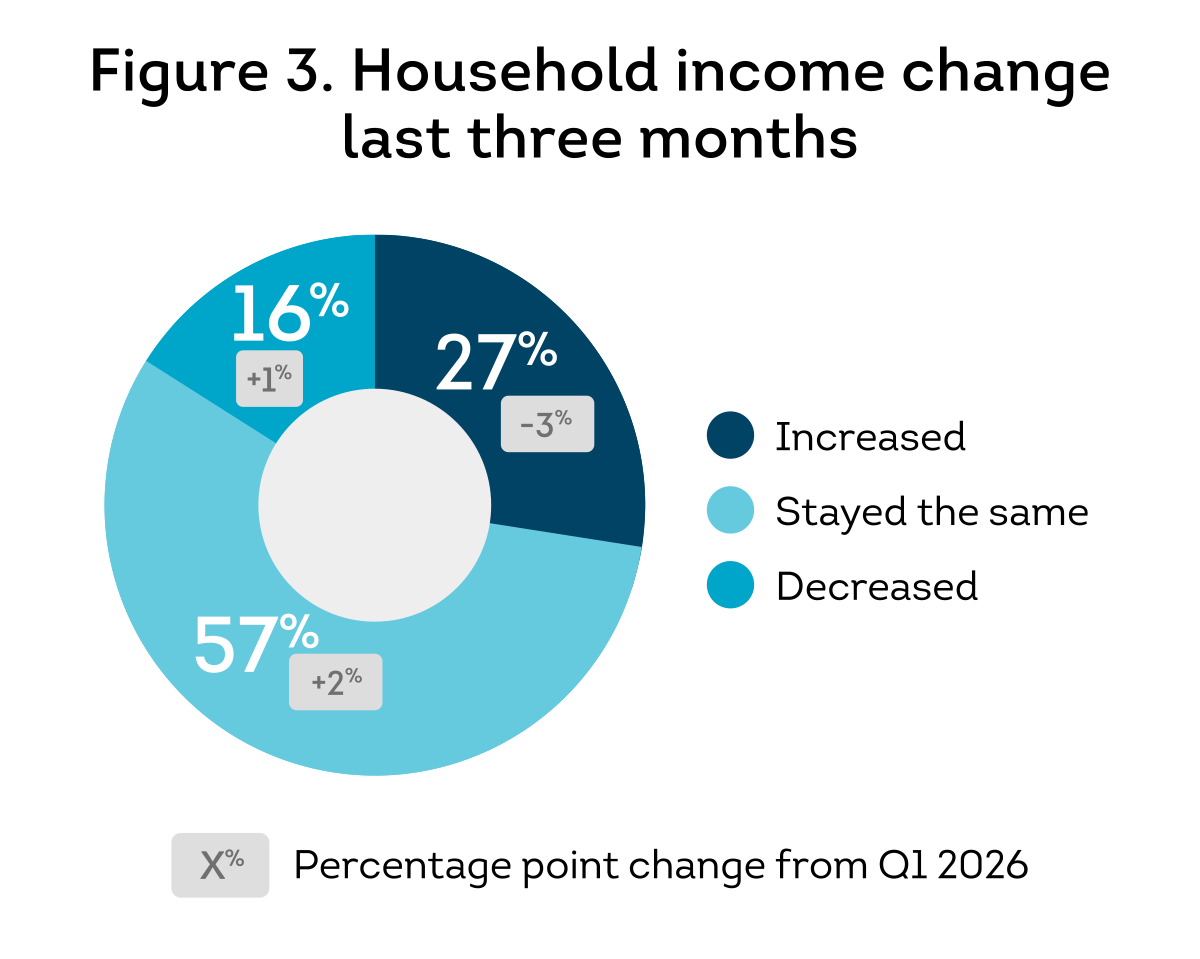
The number of consumers who said their income increased fell three percentage points from 30% a year ago to 27% in Q2 2026 — while those who said it stayed the same grew four percentage points to 57%. What’s notable was the sizeable downward shift for high-income households* impacting the overall trend; just 32% said their income increased (down 10 percentage points from Q2 2025), while 59% said it stayed the same (up 11 percentage points). Moderating incomes mean business leaders should consider sharpening their pricing,  messaging and offer strategies for consumers who may be more responsive to value  while continuing to support aspirational lifestyle messaging where appropriate. 

wallet icon

Gas price shock driving renewed inflation anxiety

Inflation was the top household financial concern for consumers, rising from 47% a year ago  to 50% in Q2 2026. It also ranked highest of the top three concerns for 83% of consumers,  up two percentage points from last year. The recent spike in gas prices kept inflation top of mind as 71% of consumers said they’re very concerned with rising gas prices, a 43% increase year over year (YoY) and a dramatic 90% increase from Q1 2026. Organizations should closely monitor shifting consumer behavior in relation to inflation to mitigate downside risks while leaning into opportunities to support consumers realigning spending to macro-economic realities. 

wallet icon

Gen X feels the affordability squeeze most sharply

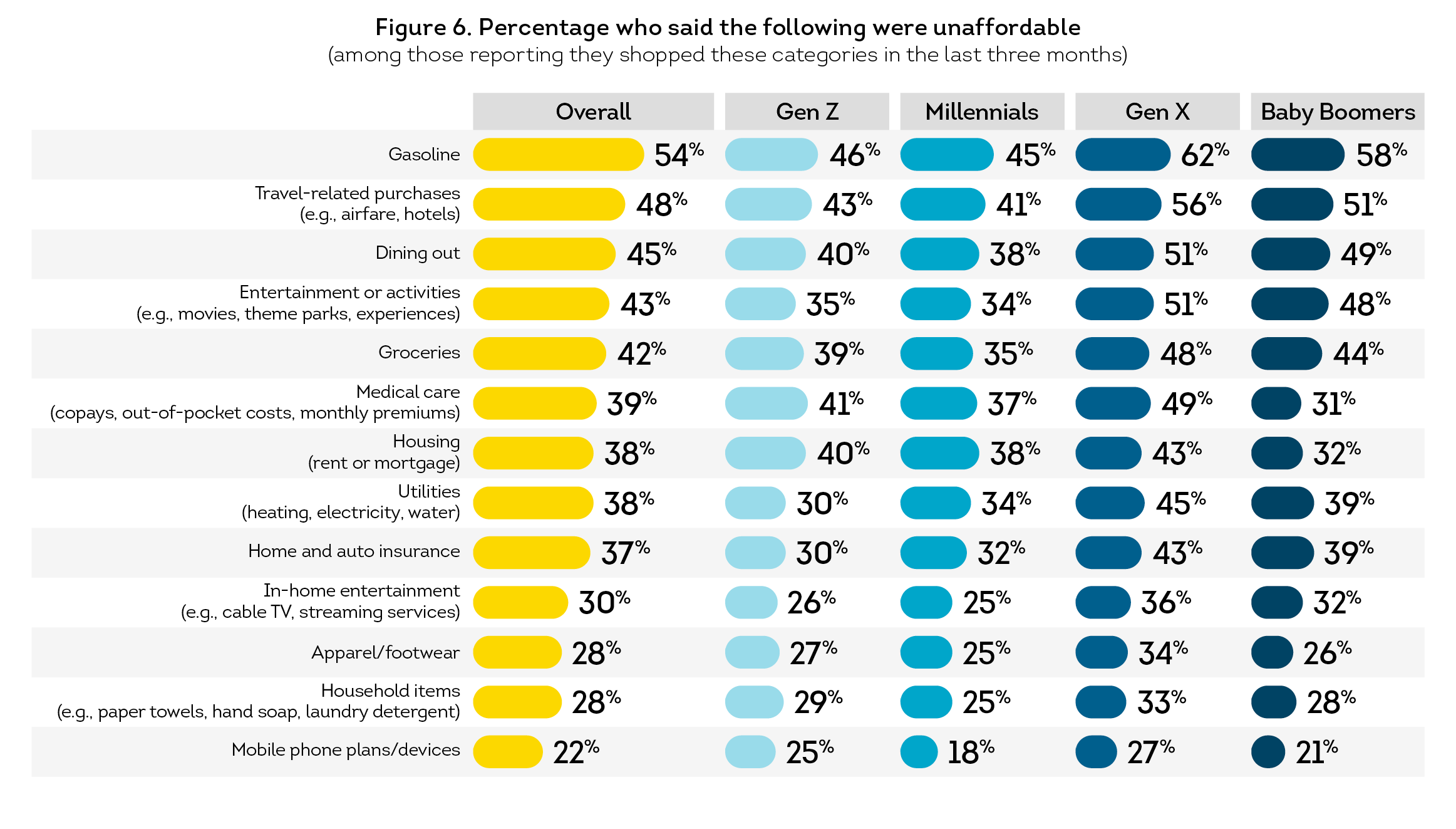
The so-called sandwich generation, middle-aged adults who may be simultaneously caring for their aging parents and their own children, is truly feeling the financial pinch. Across all 13 spend categories measured in the last three months, a higher percentage of Gen X* found them the most unaffordable than other generations. Not surprisingly, just 63% of Gen X said their household finances were as planned or better compared to 74% for Gen Z, 71% of Millennials  and 67% of Baby Boomers. For organizations that target Gen X, their affordability mindset  may lead to trading down to value brands, rightsizing their spend while maintaining their  lifestyle or creating refinancing opportunities to reduce budgetary strain. 

Financial Health

Household finances stable as inflation anxiety rises

Inflation and affordability have dominated the US consumer mindset since the end of the COVID-19 pandemic. In Q2 2026, US households appeared to be maintaining their financial standing despite economic headwinds, but high-income consumers showed some strain. Rising prices and moderating income will impact discretionary spending and consumers’ ability to pay bills. While it’s yet to be seen when high gas prices will retreat, organizations should plan for inflation continuing to animate consumer behavior. In response, business leaders should reevaluate value — refining the balance of offer and price  to better align with shifting consumer realties.

Cautious optimism persists as household finances remained steady

Consumers appeared to be managing through the spike in gas prices for the time being; 68% said their household finances were as planned or better. The longer-term trend was positive as those who responded “as planned” increased four percentage points from Q2 2025, but since last quarter, those  who said their household finances were worse than planned jumped four percentage points.

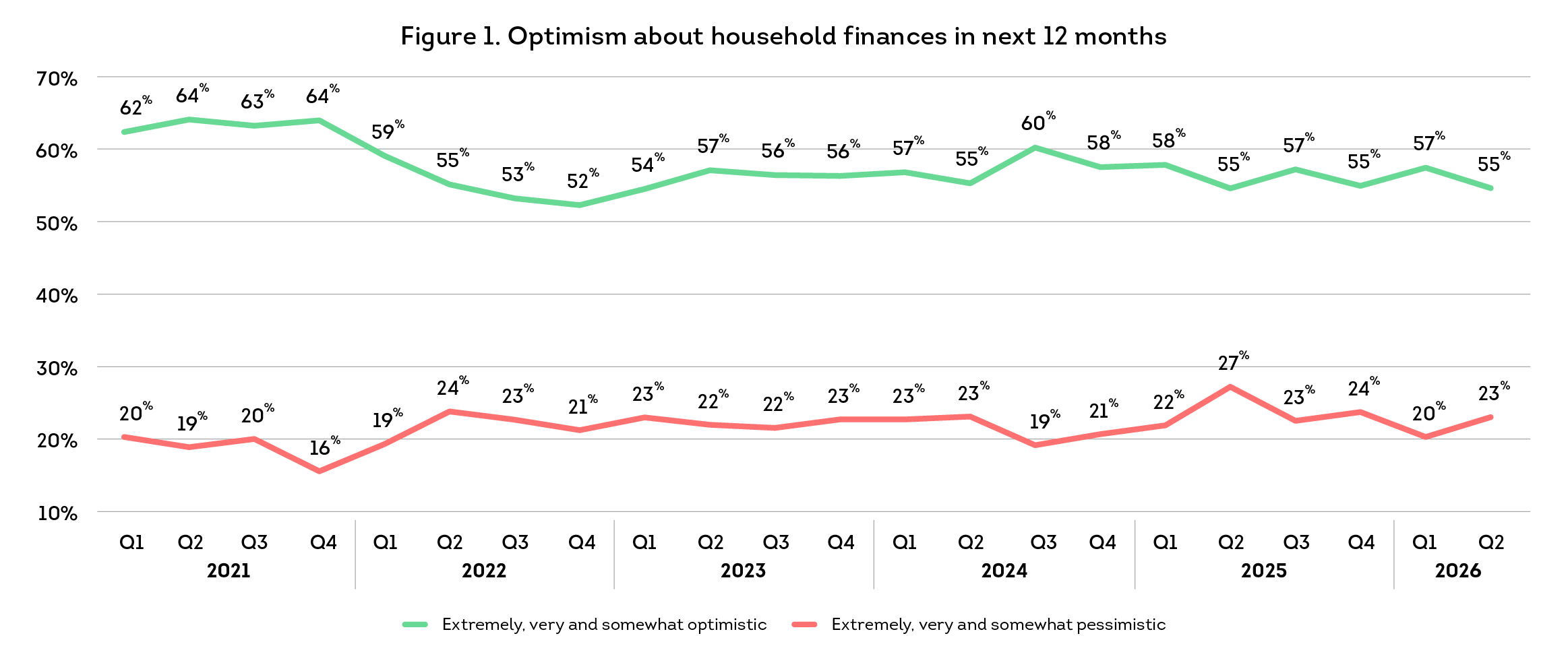
Consumers appeared resilient with more than half saying they were optimistic about their household finances in the next 12 months, unchanged since last year (Figure 1). At the same time, more consumers seemed ambivalent about their financial outlook; fewer American’s said they were pessimistic than a year ago and more indicated they were neither optimistic nor pessimistic (up four percentage points to 22%). Differences by generation tell a more nuanced story of consumer outlook. Optimism declined with age as Gen Z (68%) and Millennials (63%) had a significantly more positive outlook  compared to Gen X (52%) and Baby Boomers (44%). 


4165450-cpr-us-q2-in-line-fig-1.png

Many households not keeping up with inflation, shaping perceptions of affordability

Overall, 42% of consumers said their household income wasn’t keeping up with inflation compared to 34% who said it was — basically unchanged since Q2 2025 — while 23% were neutral. Overall, high-income consumers said their income kept up with inflation more than medium- and low-income consumers  (45% compared to 35% and 23%, respectively), yet fewer said so in Q2 2026 (down eight percentage points from 53% in Q2 2025). The shift led to more high-income consumers holding a neutral and negative attitude about their income keeping up with inflation, each increasing four percentage points YoY to 21% and 34%, respectively.

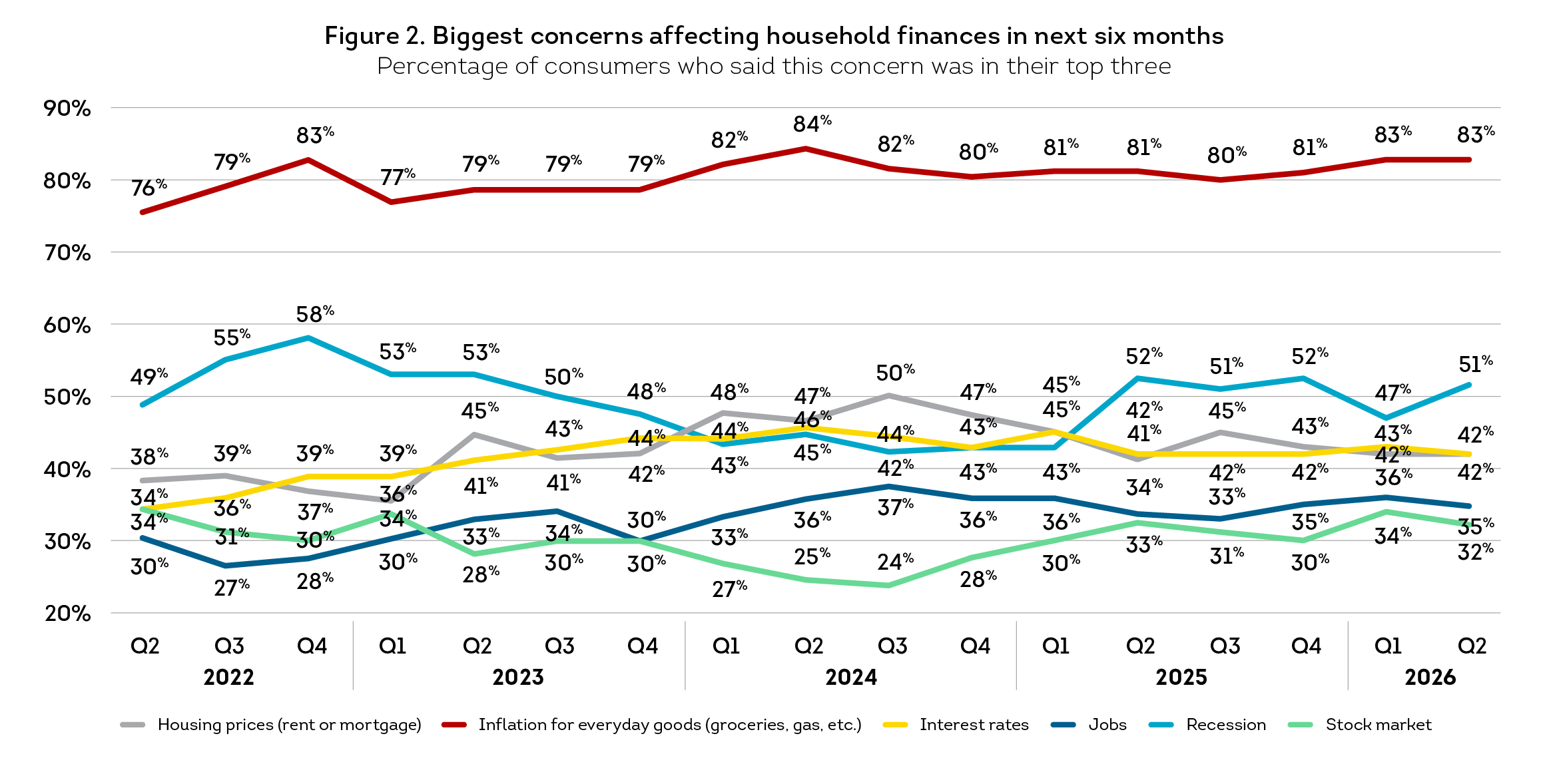
Consumers ranked inflation first among their top three financial concerns — near the all-time high. (Figure 2). Price growth for groceries (80% said increases for these were very concerning) continued to dominate consumer inflation concerns, but consumers very worried about gas price increases jumped  to 71%, up 22 percentage points YoY and 34 percentage points over last quarter. 

4165450-cpr-us-q2-in-line-fig-2.png
4165450-cpr-us-q2-in-line-fig-3.png
4165450-cpr-us-q2-in-line-fig-4.png
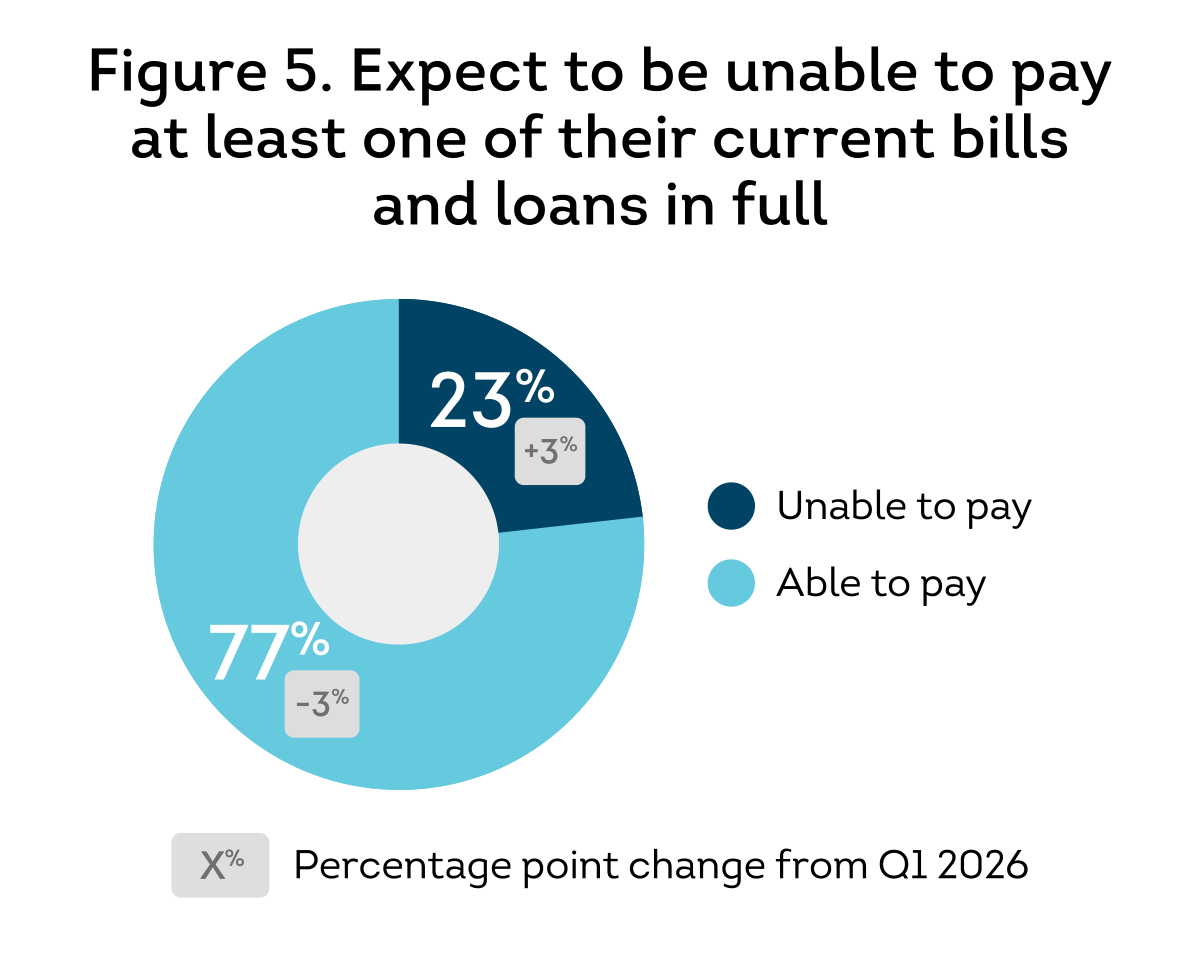
4165450-cpr-us-q2-in-line-fig-5.png

Gen X found every category of spending more unaffordable than other generations

Not surprisingly, gas topped the list of purchases consumers cited as least affordable in the last three months (Figure 6). Gen X was the age group that reported the highest level of unaffordability across every category. Gen Z and Millennials felt most of their purchases were more affordable than unaffordable — with the exception of gas, travel, dining out, medical care and housing for Gen Z, and gas and travel for Millennials. 

4165450-cpr-us-q2-in-line-fig-6.png

Inflation concerns drive pullback in discretionary spending

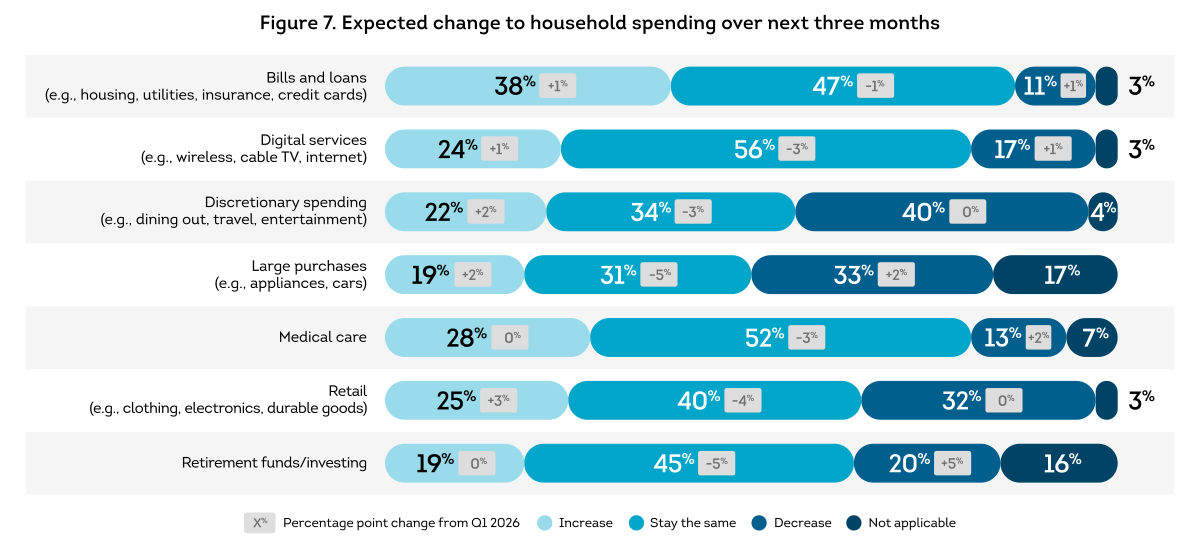
Consumers for whom inflation was a top three financial concern held more negative attitudes about their financial outlook and planned less spending in the coming months. Just 30% of inflation-concerned consumers said their income is keeping up with inflation compared to 58% for all others, and 34% said their household finances were worse than planned compared to just 18% for all others. Consequently, 43% of inflation-concerned consumers planned to cut discretionary spending in the next three months compared to 23% for all others. Overall, consumers appeared focused on managing their debt as more said they planned to increase spending on bills and loans than any other category (Figure 7).

4165450-cpr-us-q2-in-line-fig-7.png

Financial Inclusion

Inflation and interest rates pulling credit demand in opposite directions

While fewer consumers said they plan to seek credit in the next year compared to a year ago, the outlook  for lenders is nuanced: The US credit market is becoming increasingly K-shaped, with super prime consumers gaining strength while non-prime borrowers face mounting financial pressure. Some consumers appeared concerned about interest rates rising and may seek to lock in more favorable rates. At the same time, other consumers concerned about inflation said they’re less likely to seek credit. Lenders should sharpen their risk strategies to account for affordability while identifying ways to support struggling consumers working to better manage their household budgets.

Credit intent softens for most consumers

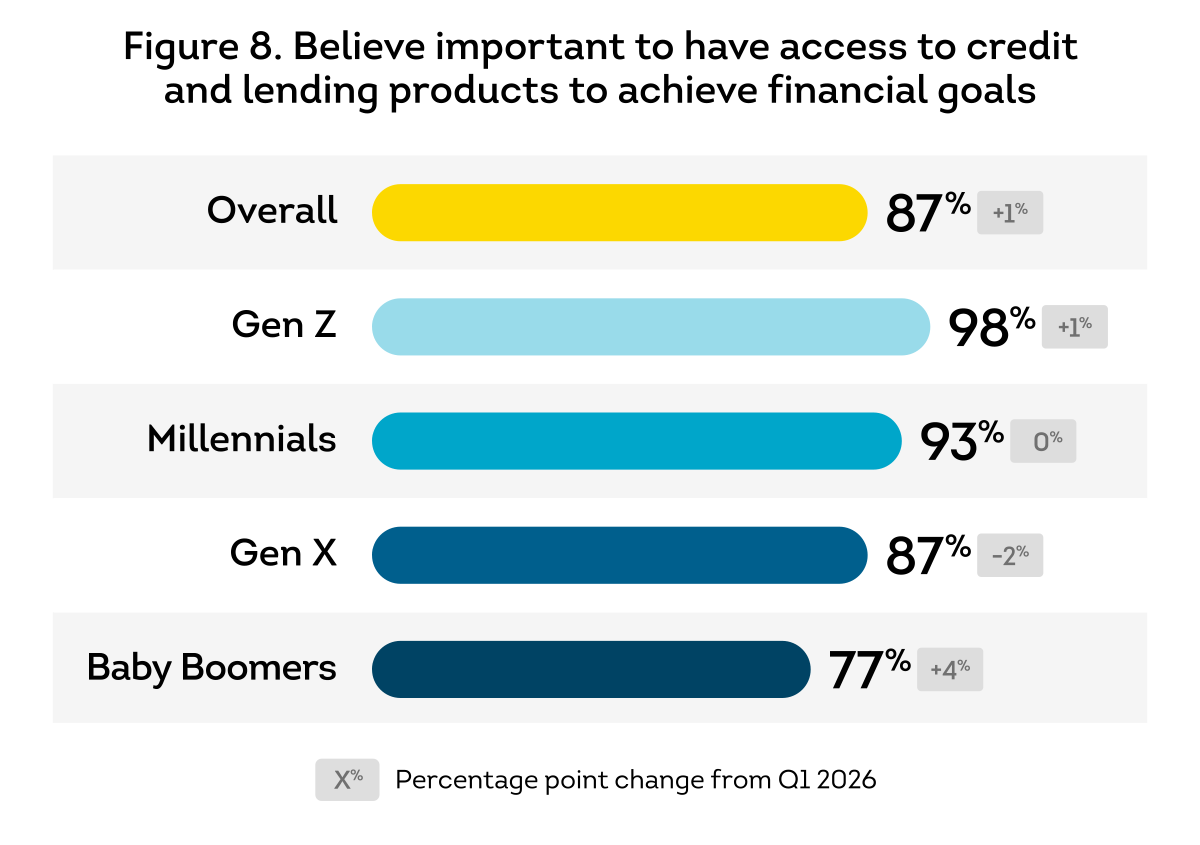
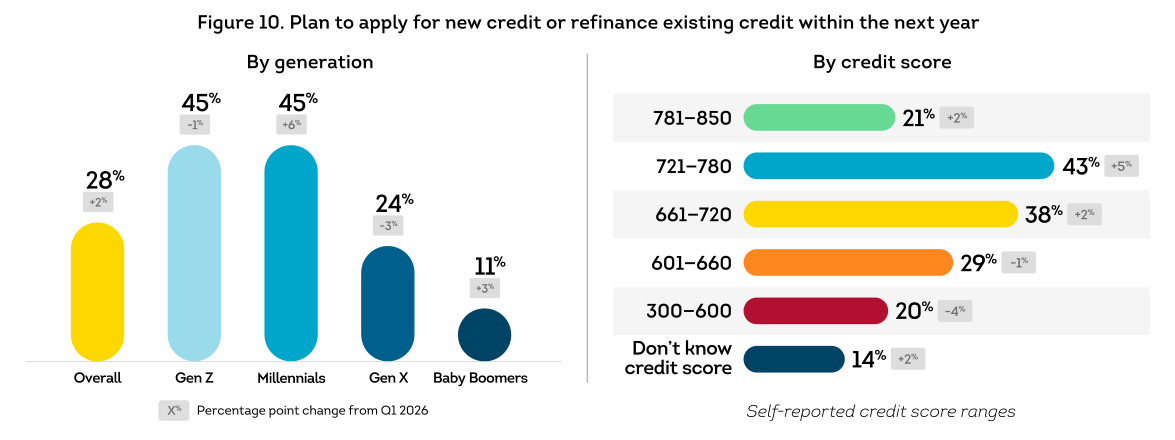
Fewer (28%) consumers planned to apply for new or refinance existing credit (Figure 10) compared to  Q2 2025 (33%). This was consistent across generations but more apparent for Gen Z and Millennials whose plans for credit dropped to 45% from 50% a year ago. While low- and medium-income consumers reported little change in credit plans, high-income consumers indicated a significant 13-percentage-point drop (from 44% in Q2 2025 to 31% in Q2 2026) in plans to seek credit in the next year. 

4165450-cpr-us-q2-in-line-fig-8.png
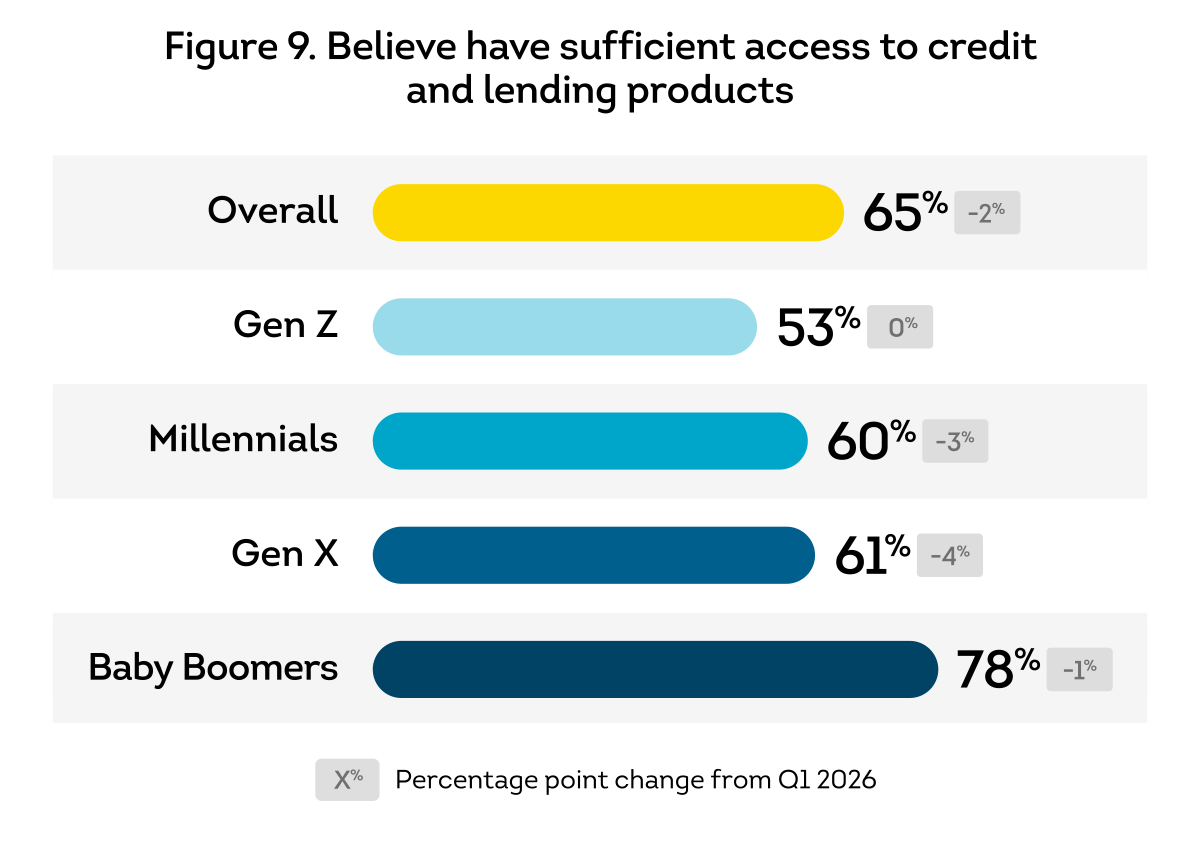
4165450-cpr-us-q2-in-line-fig-9.png
4165450-cpr-us-q2-in-line-fig-10.png

Financial pressures reshape how consumers approach credit

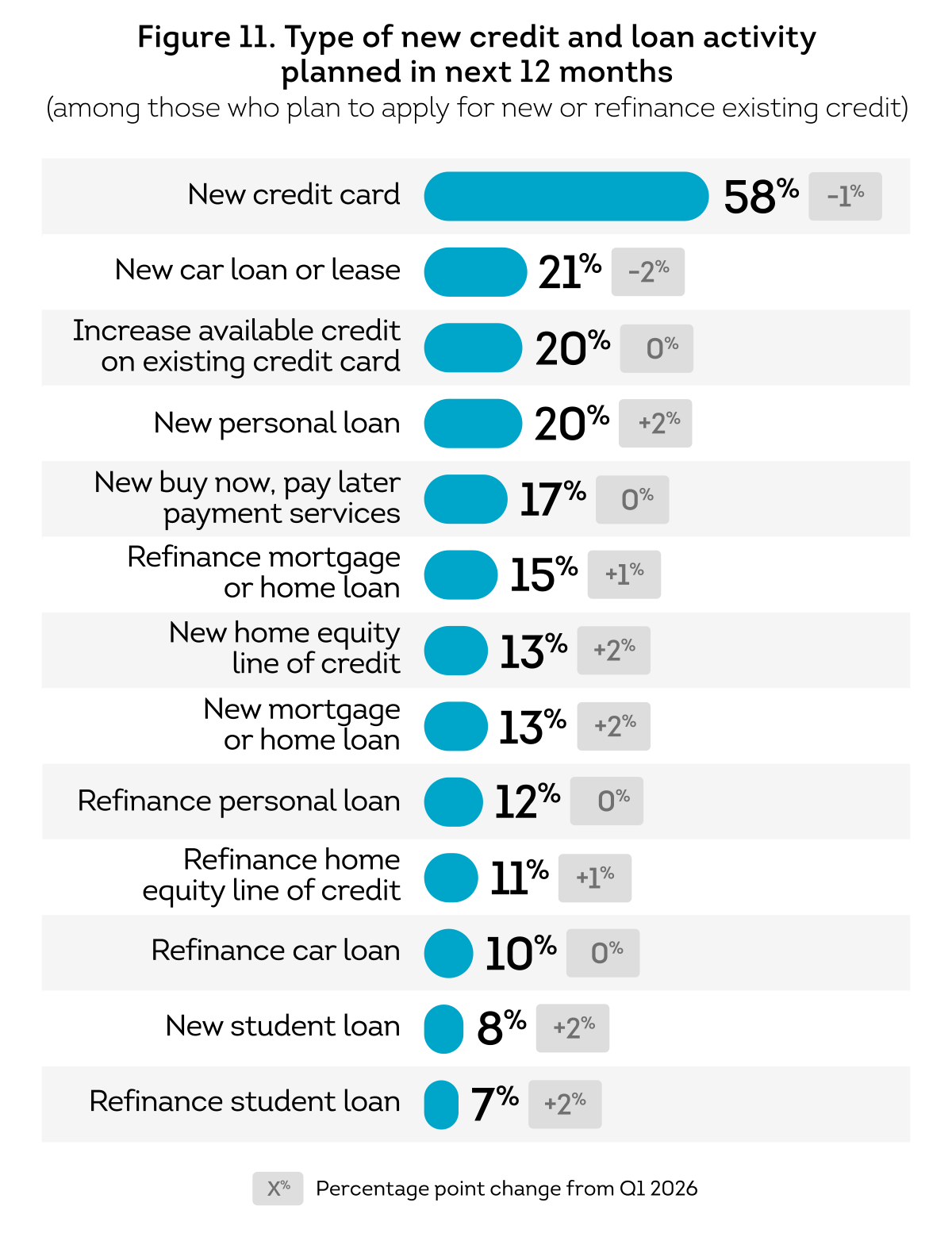
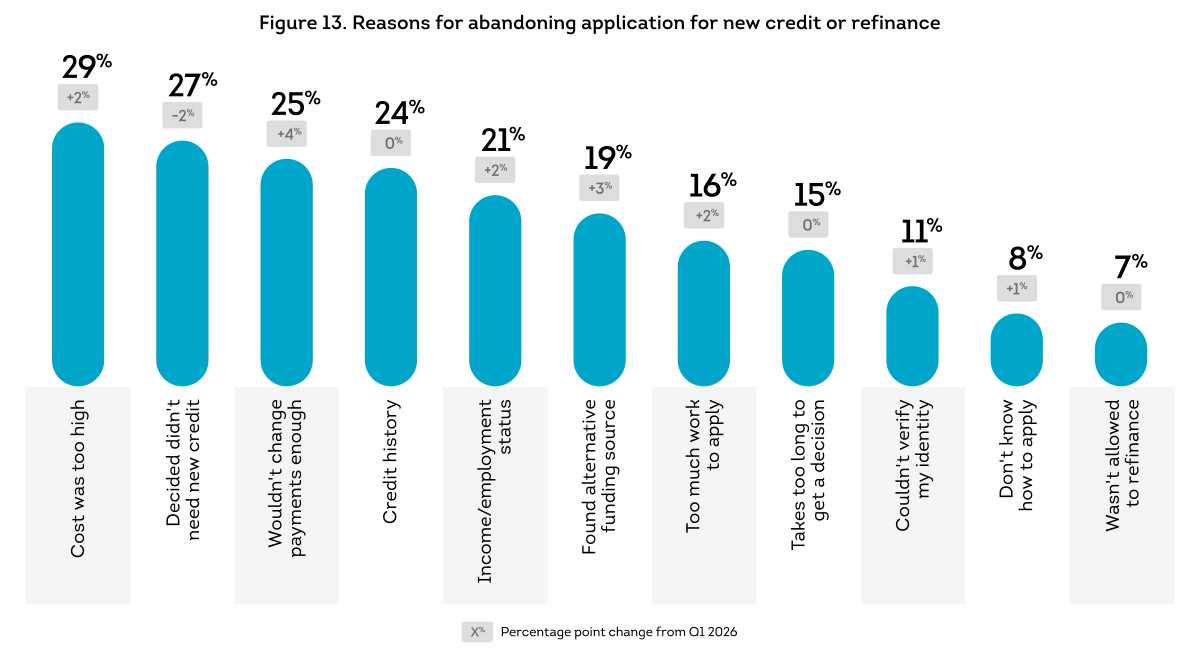
Interest rates ranked third among top three household financial concerns for 42% of Americans in Q2 2026 (Figure 2). Yet more of those who ranked interest rates as their top three concern said they planned to seek new or refinance existing credit in the next year; 31% compared to just 27% of all others in the coming year. It’s possible they may be looking for opportunities to refinance if interest rates drop. Interest rate-concerned consumers who said they’ll seek credit were more likely to refinance a personal loan (15% vs. 9% of all others) or refinance a home equity loan (14% vs. 8%) and much less likely to apply for a new credit card (54% vs. 61%).

At the same time, inflation-concerned consumers were much less likely to say they’d seek new or refinance existing credit in the next year. Just 25% of inflation-concerned consumers planned to pursue credit compared to 47% of all others. Inflation-concerned consumers who said they’ll open new or refinance existing credit were much less likely to refinance a car loan (7% vs. 18% of all others) or refinance a student loan (4% vs. 15%). Yet 60% said they’d apply for a new credit card compared to 53% for all others.


4165450-cpr-us-q2-in-line-fig-11.png
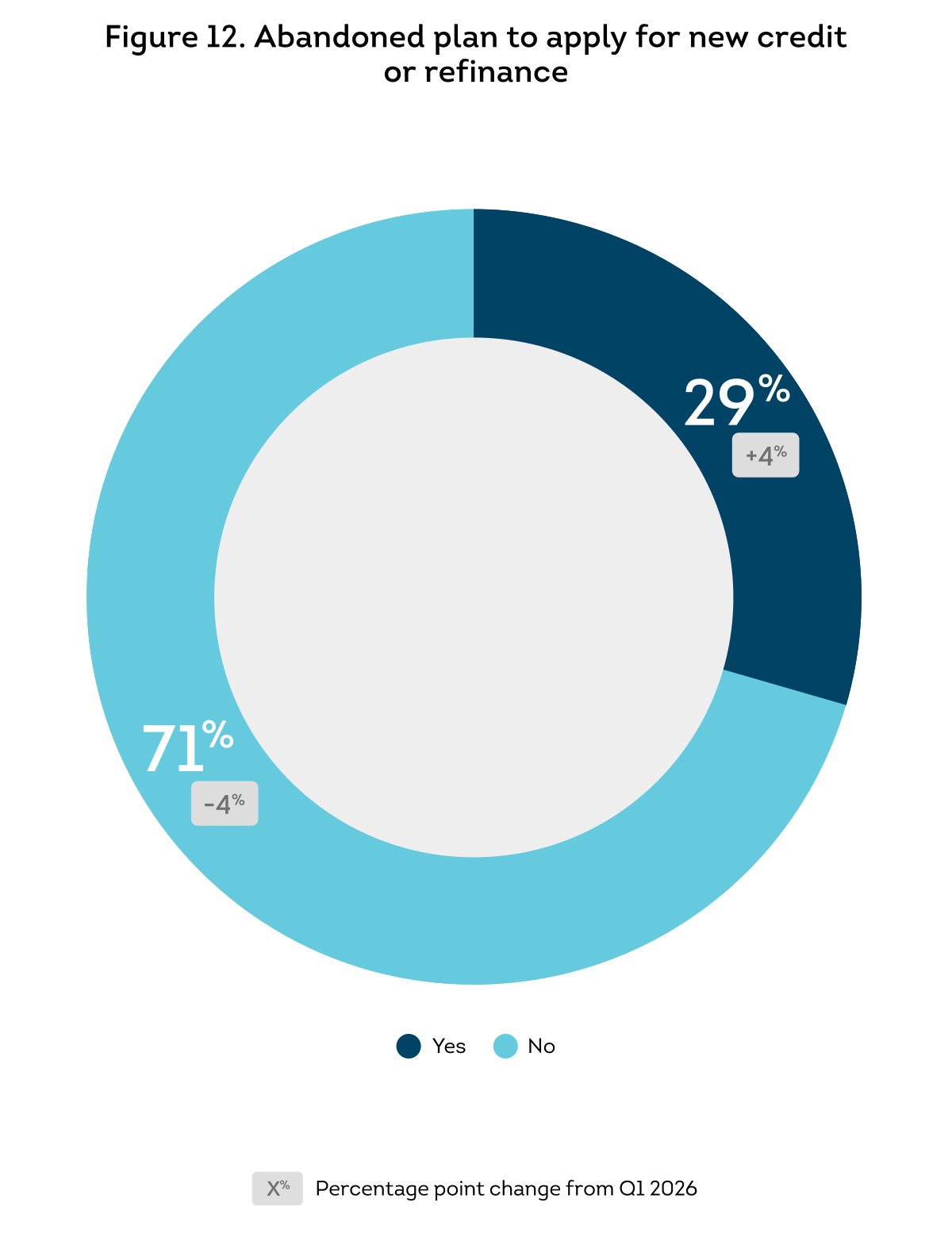
4165450-cpr-us-q2-in-line-fig-12.png
4165450-cpr-us-q2-in-line-fig-13.png

Consumer Empowerment

Credit monitoring empowers consumers amid rising AI skepticism

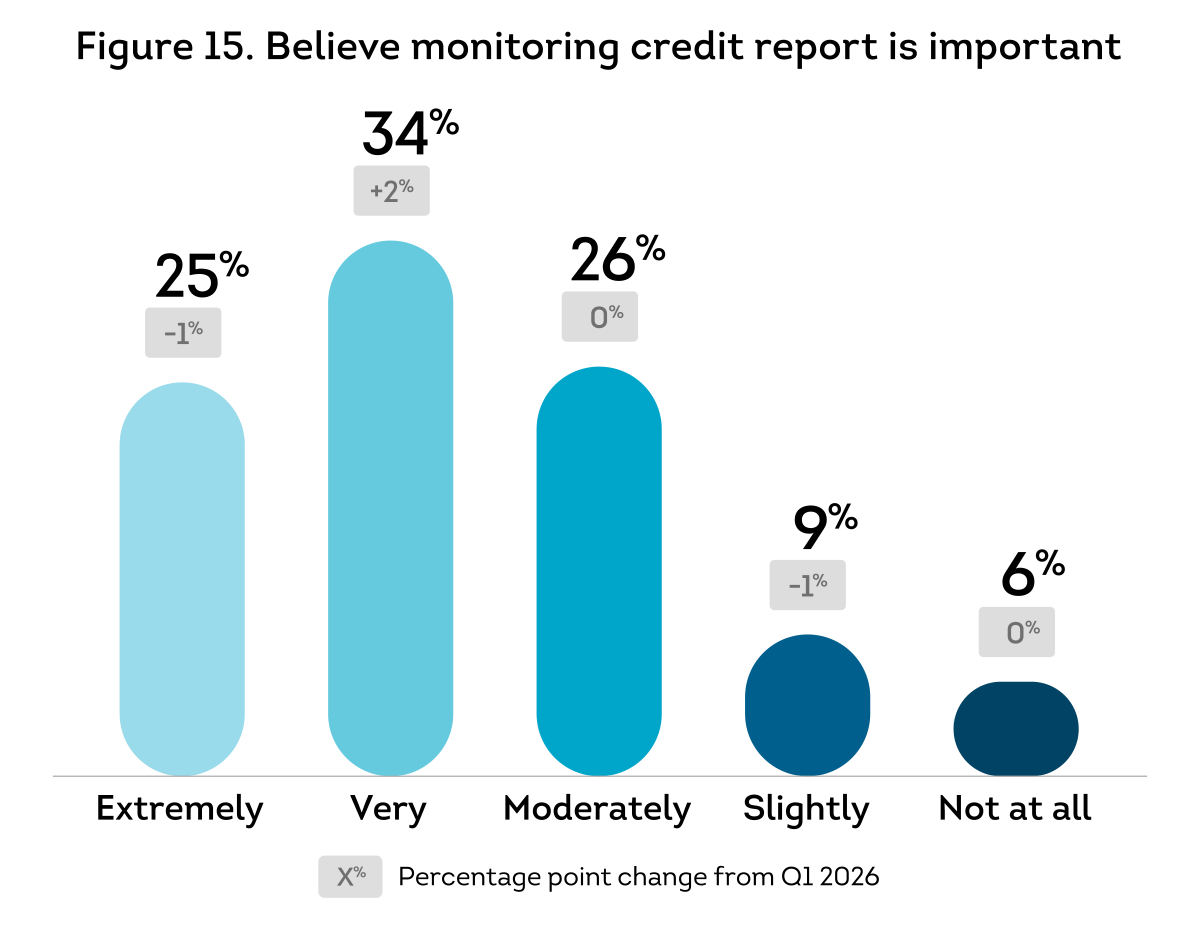
More than half (59%) of US consumers believed monitoring their credit report was extremely or very important (Figure 15). Credit reports are viewed as a tool to protect financial health and improve access. At the same time, attitudes about the personal benefits of AI are trending downward. Organizations should take advantage of consumers’ active engagement with credit monitoring as a tool to manage their financial health. There are opportunities to build trust with consumers by offering programs and tools that help them achieve their goals. That said, organizations need to carefully calibrate their messages about the personal benefits of AI as consumer attitudes have been increasingly negative. 

Younger consumers lead in credit monitoring as they build their credit profiles

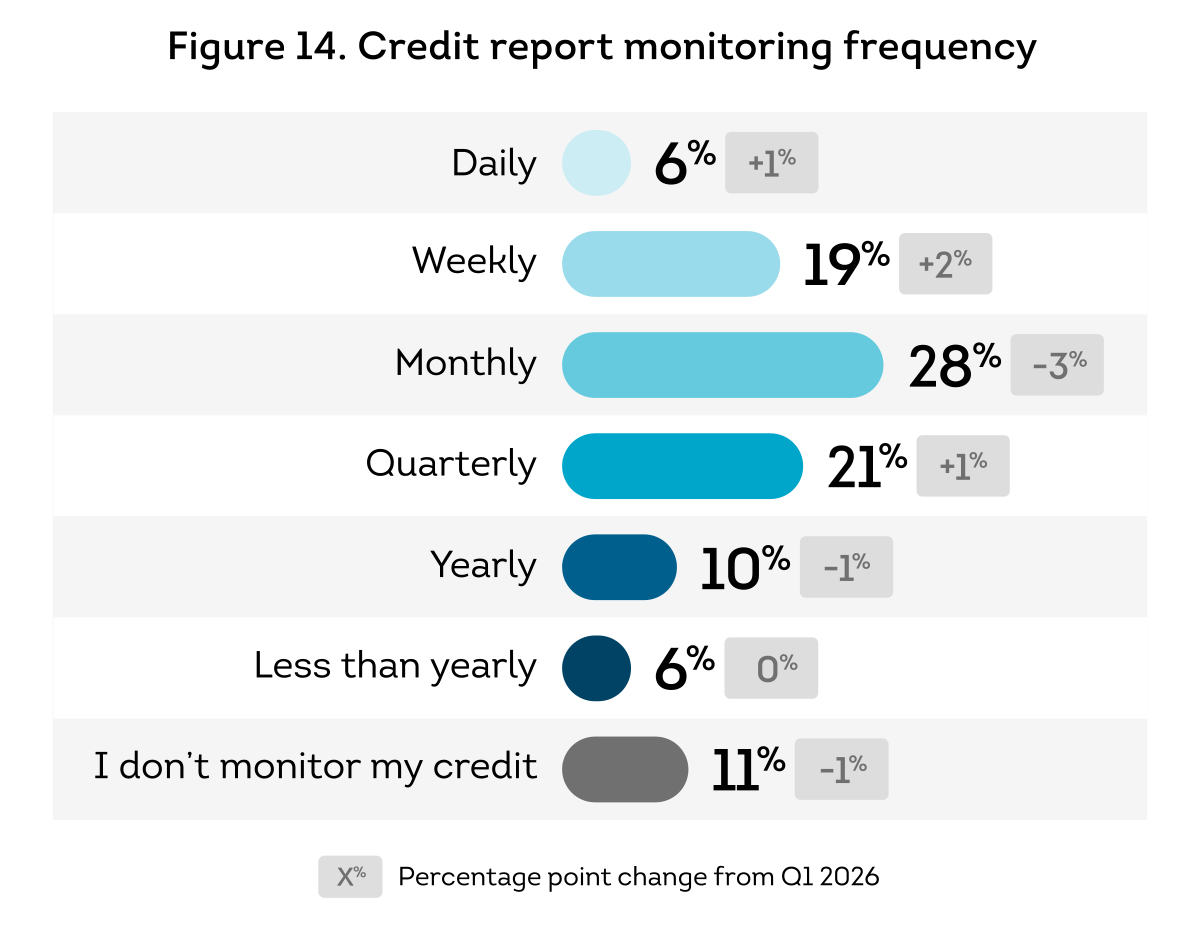
The majority (53%) of consumers reported monitoring their credit at least monthly (Figure 14). Younger generations appeared most active as Millennials (64%) and Gen Z (61%) reported monitoring their credit at least monthly, the highest among all generations. Gen Z (41%) and Millennials (39%) were also the two generations who most reported credit score improvement as their reason for credit monitoring. 

Older consumers prioritize financial protection

In addition to helping improve their credit histories, Americans use credit monitoring to protect themselves. Among Americans who reported monitoring their credit reports, 45% said they did so to monitor for accuracy (up three percentage points over Q2 2025) and 47% to protect against fraud  (up two percentage points). Protecting against fraud was the top reason Baby Boomers (60%) and  Gen X (54%) gave for monitoring their credit reports, much higher than Gen Z and Millennials. 

4165450-cpr-us-q2-in-line-fig-15.png

Sentiment toward AI turns more negative among consumers

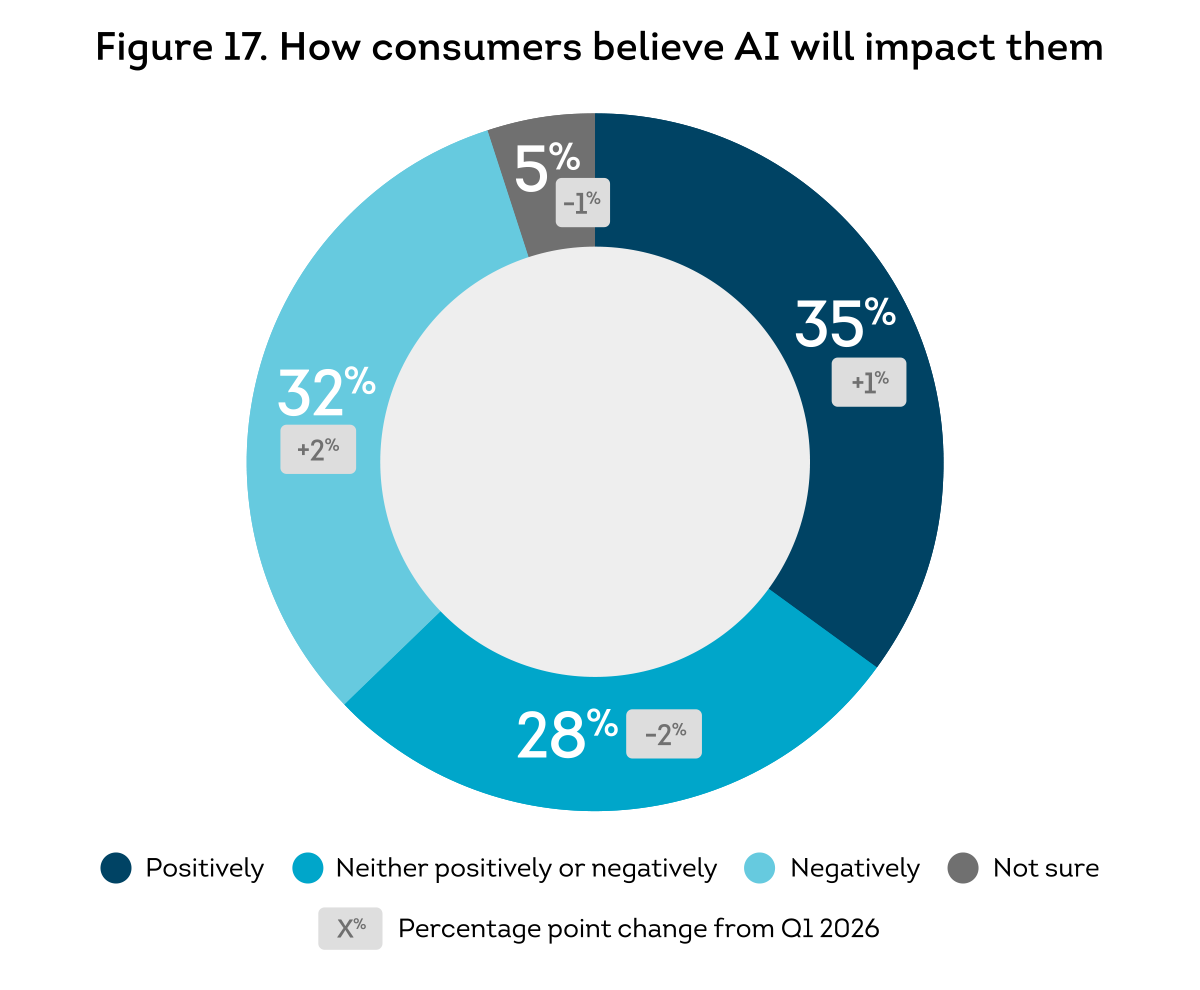
Consumers have mixed feelings about artificial intelligence, but belief it will have a positive impact on their lives in the long term has faded in the past year (Figure 17). While more than a third (35%) said they believed AI would have a long-term positive impact on them, that fell from 39% in Q2 2025. As well, those with a negative outlook grew from 25% last year to 32% this quarter. When asked to select the top three potential long-term impacts of AI, consumers were more likely to say job displacement (30%, up four percentage points) and environmental impacts (18%, up six percentage points) and less likely to say improved work productivity (19%, down five percentage points) compared to a year ago.

4165450-cpr-us-q2-in-line-fig-16.png
4165450-cpr-us-q2-in-line-fig-17.png

Identity Protection

More sophisticated scams appear to be increasingly slipping past consumers

Consumers are more wary about the risk AI poses to them personally. When asked to select the top three potential long-term impacts of AI on them, consumers’ top answers were the unethical use of AI (48%), privacy and security concerns (44%), and increased identity fraud attempts (33%). Based on current fraud trends, their concerns don’t appear misplaced, but consumers need to do more to protect themselves. The implication for business leaders facing a consumer who’s increasingly cautious about managing their financial health is the need to double-down on trust. Reinforce trust as a brand value by strengthening account and data security features — and promoting them clearly so consumers understand and use them. Also, develop strategies to reduce organizational impersonation scams and detect increasingly sophisticated fraud schemes driven by compromised consumer data.

Most Americans unaware they’ve been targeted by fraud despite prevalence of consumer scams

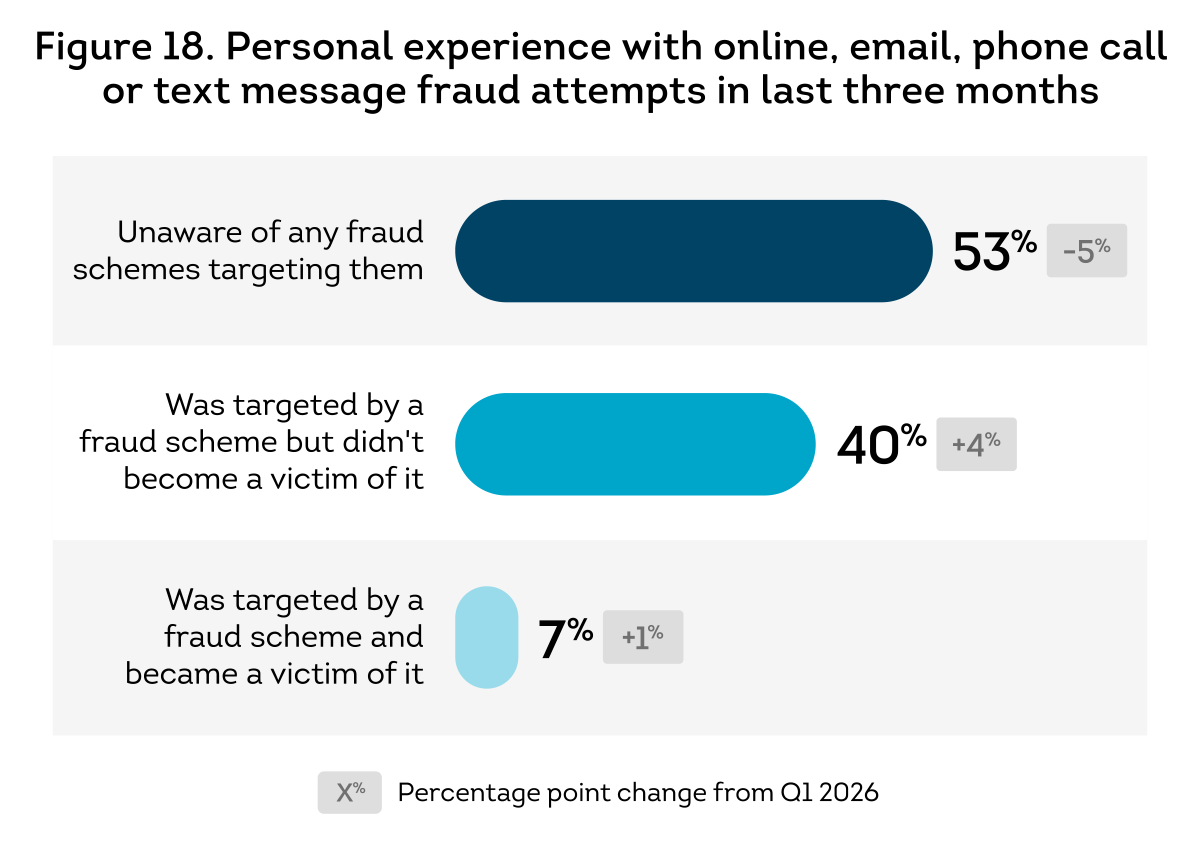
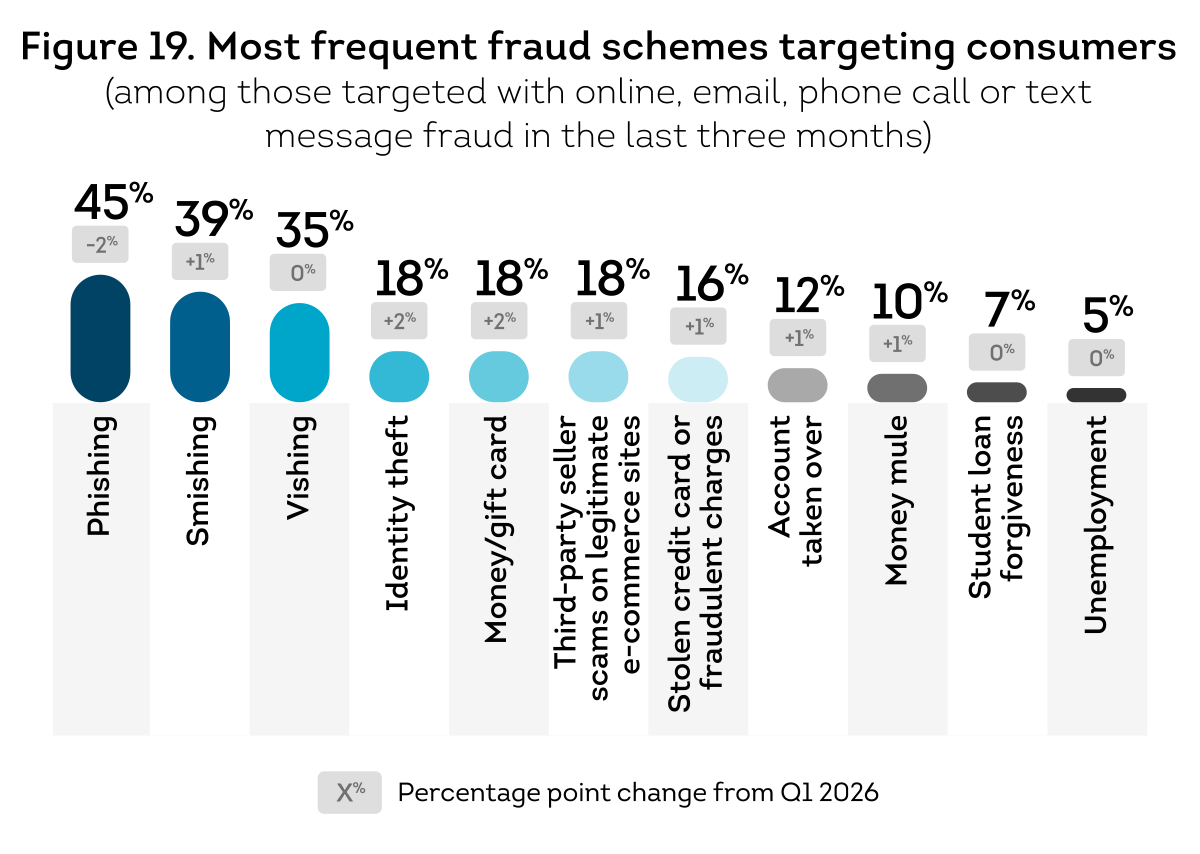
More than half of consumers said they were unaware of being targeted by online, email, phone call or text messaging fraud in the last three months compared to 47% who were targeted (Figure 18). In addition, more than a quarter (28%) of Americans said they were notified details about their identities and/or online accounts were stolen in a data breach in the last three months — down YoY but up two percentage points over last quarter. At the same time, identity-based fraud scams — getting consumers to share sensitive information, unknowingly grant access to online accounts or send money to criminals — were the leading reported fraud schemes in Q2 2026 (Figure 19).

4165450-cpr-us-q2-in-line-fig-18.png
4165450-cpr-us-q2-in-line-fig-19.png

Responses to data breaches lag behind rising identity theft concerns

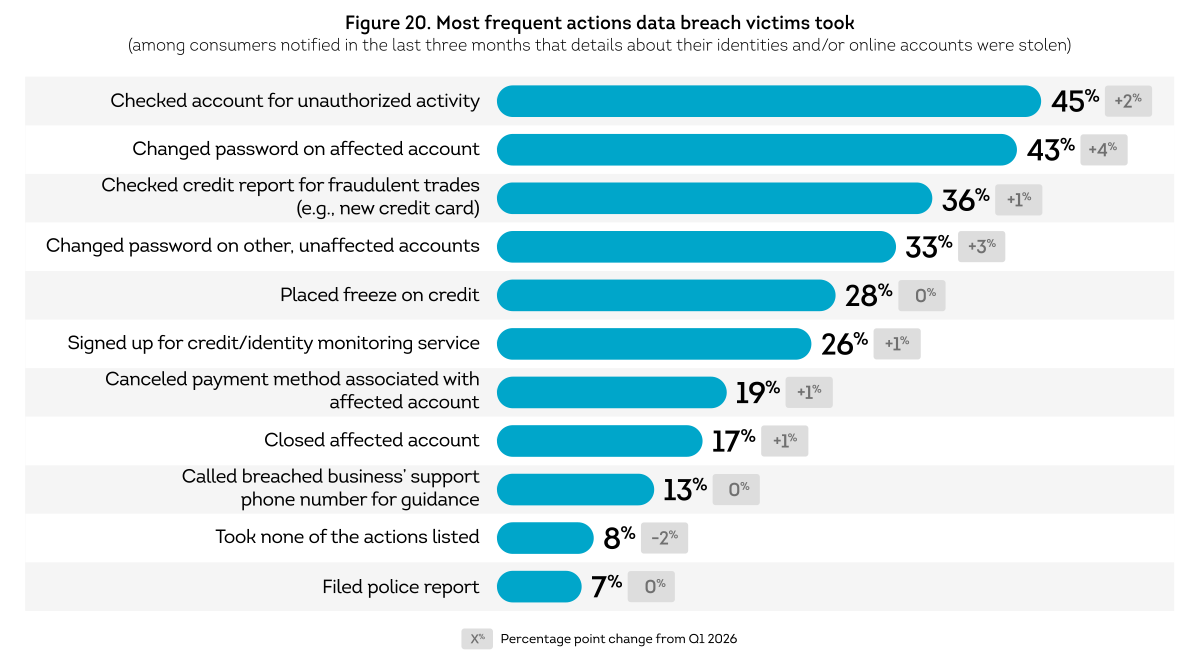
Overwhelmingly, 60% of consumers said identity theft was the cyber threat that most concerned them — followed by credit card fraud at 49%. However, when notified their information was exposed in a data breach in the last three months, less than half took action to protect themselves, such as checking the affected account for unauthorized activity or changing the password on the affected account (Figure 20). Even fewer took action to ensure their identities weren’t being used to open unauthorized credit lines. Of concern to organizations, 17% of consumers said they closed the affected account after experiencing a data breach. 

4165450-cpr-us-q2-in-line-fig-20.png

Cyber threat concerns prompt limited consumer protective actions

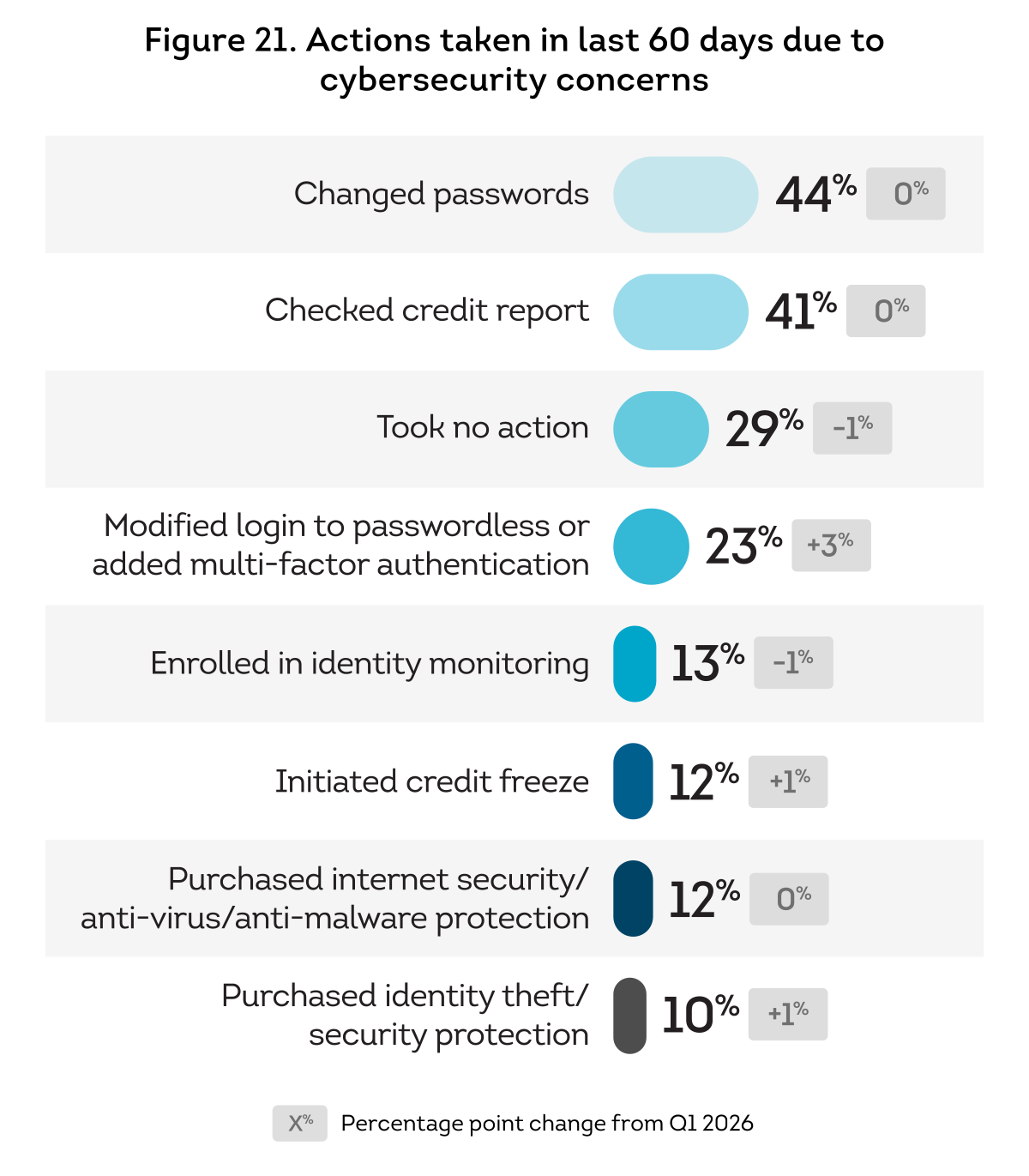
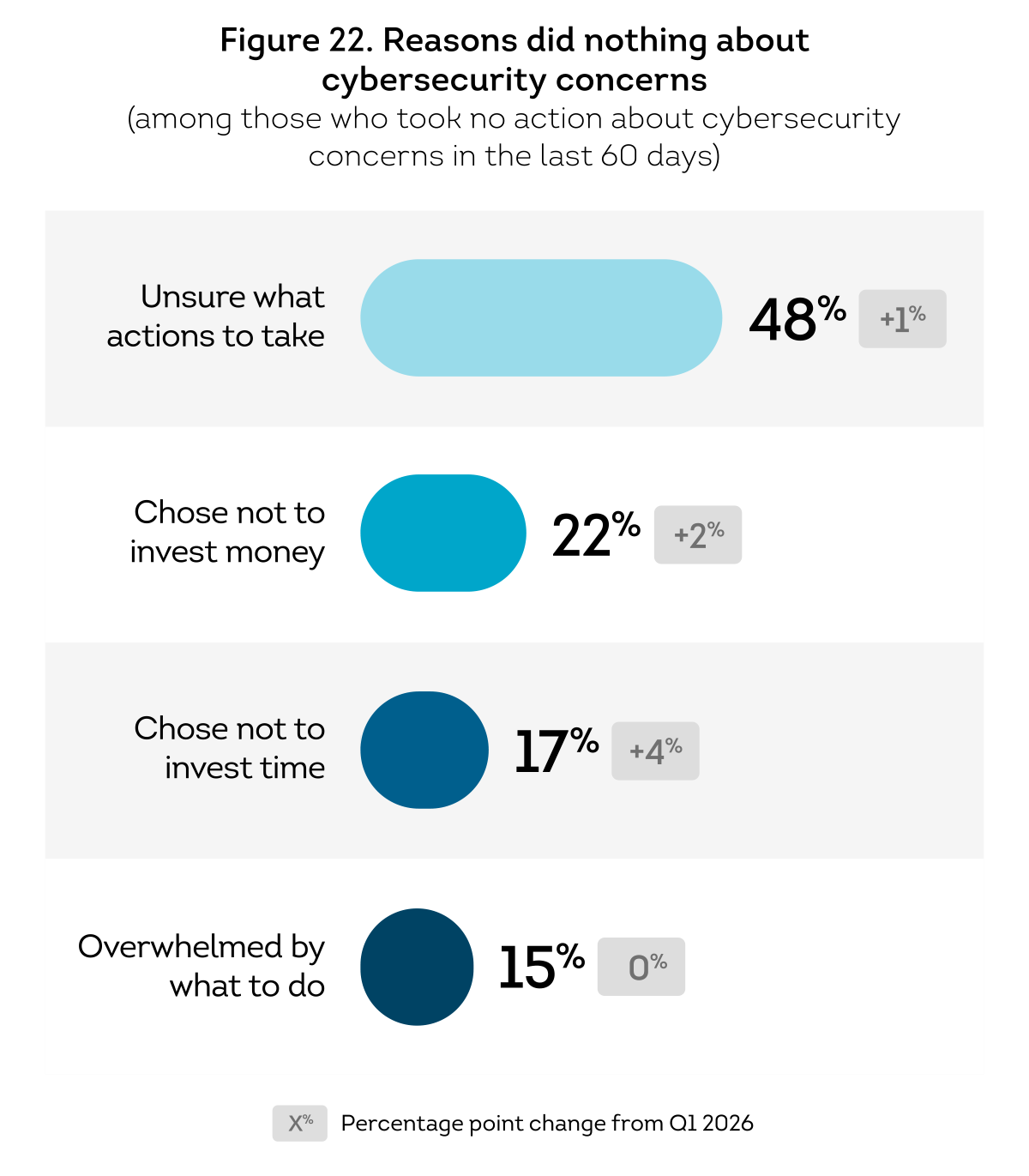
Less than half of consumers concerned about cybersecurity took active steps to protect themselves in the last 60 days, such as changing online account passwords and monitoring their credit reports for unauthorized accounts (Figure 21). And more than a quarter said they took no action, mainly because they weren’t sure what to do — an opportunity for organizations to educate and enlist consumers to better protect their accounts. 

4165450-cpr-us-q2-in-line-fig-21.png
4165450-cpr-us-q2-in-line-fig-22.png

Research Methodology

This online survey of 2,996 adults was conducted April 23–May 11, 2026 by TransUnion in partnership with third-party research provider, Dynata. Adults 18 years of age and older residing in the United States were surveyed using an online research panel method across a combination of desktop, mobile and tablet devices. Survey questions were administered in English. All states were represented in the survey responses. To ensure general population sample representativeness across United States resident demographics, the survey included quotas to balance responses to the census statistics on the dimensions of age, gender, household income, race and region. Generations were defined in this research as follows: Gen Z, 18–29 years old; Millennials, 30–45; Gen X, 46–61; and Baby Boomers, age 62 and above. Household income ranges were defined as low income (annual income less than $49,999), middle income ($50,000$99,999) and high income ($100,000 or above). These research results are unweighted and statistically significant at a 95% confidence level within ± 1.8 percentage points based on calculated error margin.  Please note some chart percentages may not add up to 100% due to rounding or multiple answers  being accepted.

For Consumer Pulse Studies worldwide, visit 
transunion.com/consumer-pulse-study

Disclaimer: The information posted here was accurate at the time it was initially published. We do not guarantee the accuracy or completeness of the information provided. The information contained here is provided for educational purposes only and does not constitute legal or financial advice. You should consult your own attorney or financial adviser regarding your particular situation. For complete details of any product mentioned, visit transunion.com. This site is governed by the TransUnion privacy policy located here.