

Solving for the identity crisis at the heart of fraud
Fraud is a rapidly evolving threat.
From account creation and monitoring to account management and transactions, fraudsters exploit every stage of the consumer lifecycle, leveraging cutting-edge technology and stolen credentials to bypass fragmented defenses and cause widespread damage.
The trends impacting businesses are sobering
At the nucleus of these attacks is identity
Fraudsters manipulate or fabricate it to gain access, impersonate legitimate users and evade detection. And as fraud defenses grow more complex, maintaining a seamless customer experience becomes just as critical; overly aggressive controls can alienate good customers and erode trust. For fraud and risk leaders, the challenge is clear: Improve protection from sophisticated fraud without compromising customer experience or trust.
This guide explores how a connected, end-to-end approach to fraud prevention — anchored in a clear picture of identity — can help you detect and reduce fraud at every touchpoint.
Rising cost of fraud can’t be ignored
The equivalent revenue lost to fraud in past year, up 18% year over year, according to a 2025 TransUnion survey of 1,200 business leaders across the globe.

Why siloed defenses are failing
Many organizations rely on separate fraud teams and point solutions focused on a specific risk type or channel. While these tools may offer tactical value, they create blind spots and leave organizations exposed. Fraudsters exploit these gaps by hopping across channels — using intelligence gathered from one to attack another.
For example, a fraudster might use social engineering to extract data from a call center agent, then use that data to bypass authentication in a digital channel. Without a unified view of identity and risk signals deployed across the enterprise, organizations struggle to connect the dots — and fraud slips through.
Key challenges include:
Siloed data and systems hinder identity verification and increase false positives
Manual reviews slow down operations and frustrate legitimate customers
AI-driven fraud escalation, including synthetic identities and deepfakes
Operational complexity across fragmented departments and tools
A clear picture of identity is foundational for effective fraud prevention
Identity data is the universal enabler of fraud. Whether it’s synthetic identity fraud at account creation or account takeover during transactions, fraudsters rely on compromised or fabricated identity data to infiltrate systems.
TransUnion’s 2025 business survey found the leading causes of fraud losses — scams, account takeover and synthetic identity fraud — all stem from digital identity misuse. A clear picture of identity enables smarter decisions in real time and is essential for distinguishing between trusted users and fraudsters.
Getting that clear picture requires connected intelligence,
comprised of three key capabilities:



Addressing risk across every stage creates lifecycle-wide protection
Let’s take a quick look at the most common fraud types threatening the consumer lifecycle — and strategies to thwart them.
The challenge is clear
Protect the consumer lifecycle without compromising customer experience or trust.
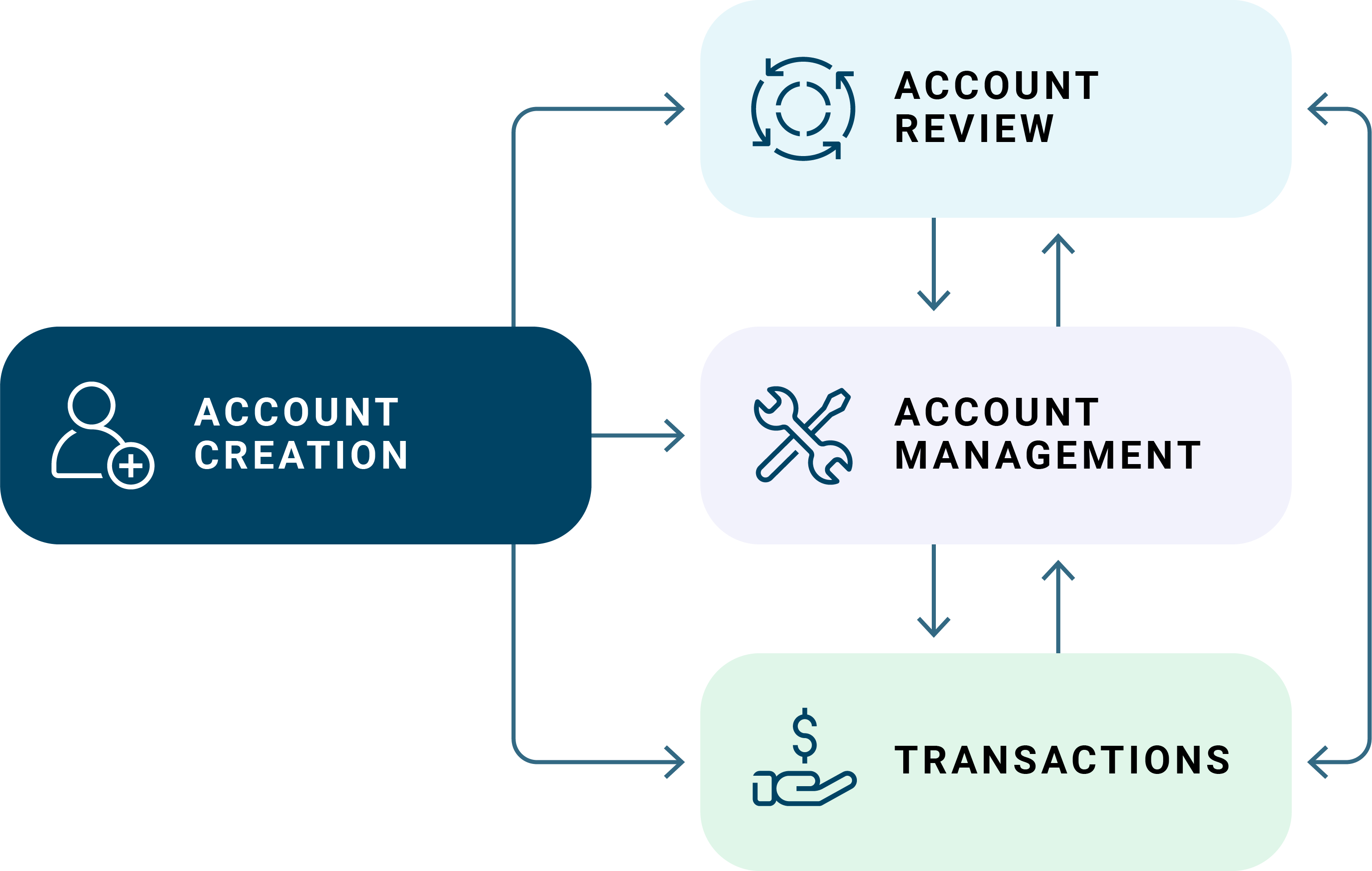
Account creation: Spot fraud before it starts
As digital and mobile channels increasingly become the default for onboarding, online account creation has become a prime target for fraud. Data breaches and GenAI have made synthetic identities harder to detect. Combined with weak digital identity resolution early in the lifecycle, these threats have led to a surge in fake profiles and fraudulent accounts — including those created by consumers with malicious intent.
Identity risks to watch for:


Without robust identity verification and risk detection at the outset, these threats can easily slip through — setting the stage for more complex fraud down the line.
Ongoing account review: Detect dormant risk
Even well-established accounts can harbor hidden threats. As fraudsters look for ways to exploit overlooked or under-monitored accounts, this stage becomes critical for detecting subtle but consequential signs of risk.
Identity risks to watch for:


Without robust identity verification and risk detection at the outset, these threats can easily slip through — setting the stage for more complex fraud down the line
Account management: Defend against takeover and identity theft
Established customer accounts are attractive targets for fraudsters who exploit digital and phone channels to gain access, harvest personal data and manipulate authentication flows. The phone channel is increasingly used for pre-crime research, spoofing and social engineering, making it a critical vulnerability.
Identity risks to watch for:


Without strong multi-factor authentication, device intelligence and phone channel safeguards, these attacks can lead to financial loss, reputational damage and erosion of customer trust.
Transactions: Separate safe from risky interactions
This is where fraud often becomes most visible — and costly. While account takeover and first-party fraud can occur earlier in the lifecycle, they frequently occur here. Distinguishing legitimate activity from fraud in real time requires a different level of precision and speed.
Identity risks to watch for:


Without real-time decisioning, device intelligence and behavioral analytics, organizations risk declining good customers, approving fraudulent transactions and losing revenue to abuse that’s difficult to dispute.
Find the gaps: Evaluate your exposure to digital identity risk
While it’s important to address the fraud-related needs of each lifecycle stage, it’s vital to recognize they don’t occur in isolation. Use the assessment below to evaluate the strength and cohesion of your fraud prevention strategies across the consumer lifecycle. The questions are designed to help you identify gaps, operational inefficiencies and strategic misalignments so you may consider how to strengthen your protections.
- Account creation
- Ongoing review
- Account management
- Transactions
- How confident are you in your ability to detect synthetic identities and stolen credentials before accounts are created?
- Are your identity verification processes rooted in connected data across channels and devices — or are they reliant on isolated point solutions?
- Can you distinguish between legitimate users and those with intent to commit first-party fraud at the point of onboarding?
- How well do your systems assess device reputation and behavior during account creation?
- Do you have continuous visibility into dormant accounts and subtle identity changes that may signal preparation for fraud?
- How effectively do you detect and respond to phishing and smishing attempts targeting existing customers?
- Are your KYC refresh processes automated, risk-based and compliant — or are they creating friction and operational strain?
- How well do you monitor for fraudulent updates to account information, and can you link those changes to broader risk signals?
- Can you reliably detect account takeover attempts across both digital and phone channels?
- How secure is your phone channel against spoofing, SIM swaps and social engineering?
- Are your authentication flows adaptive and context-aware or do they rely on static credentials and rules?
- How well do you monitor device-to-account linkages and behavioral anomalies during login and account changes?
- Are you able to separate safe from risky transactions in real time without introducing unnecessary friction?
- How effectively can you identify first-party fraud, such as chargebacks or refund abuse, without alienating legitimate customers?
- Do you have visibility into device and IP reputation at the moment of transaction?
- Are your fraud controls integrated with customer experience metrics to ensure balanced decisioning?
If your answers to these questions reveal uncertainty, fragmentation or over-reliance on manual processes, it may be time to reinforce your fraud strategies. Seeing the full picture of digital identity risk — and acting on it — requires connected intelligence across every stage of the consumer lifecycle.
Strategic recommendations for enhancing protection throughout the consumer lifecycle
Fraud is no longer a point-in-time problem. It’s a dynamic, enterprise-wide risk requiring strategies as connected and dynamic as the threats themselves. A clear picture of identity is the foundation for effective fraud prevention. Without it, every decision — across every stage of the lifecycle — is vulnerable to error, inefficiency and exploitation.
To protect your organization and customers, consider the following fundamentals:


The cost of inaction is high.
To stay ahead of evolving threats, adopt a connected intelligence strategy that delivers security, speed and trust throughout the consumer lifecycle


