

A deposit set too high can create unnecessary friction. One set too low may leave a provider exposed to greater payment risk. The challenge is making that call when traditional credit data provides an incomplete picture of an applicant’s ability and likelihood to meet payment obligations.
Some applicants may not match available records, have limited credit histories or receive a score that offers little insight into expected performance. Utility and CSP credit risk teams need a clearer basis for determining the appropriate service terms, deposit requirements, device financing options and other account treatments.
Understand what limits credit risk assessments
Applicants can be difficult to assess for different reasons. Sometimes, the challenge begins with identity. The information submitted may not be sufficient to match an applicant to available records.
In other cases, the applicant can be identified but has a limited traditional credit history, leaving fewer signals available to evaluate financial behavior.
A third applicant may receive a score, but it provides limited risk differentiation. The applicant is technically scoreable, but the result may offer little insight into differences in expected performance.
Those scenarios call for different questions. Can the applicant be reliably matched? Is enough relevant information available to assess risk? If a score is returned, does it differentiate risk in a way that supports the decision and appropriate customer treatment?
For utilities and CSPs, these insights can inform credit risk decisions at account opening and beyond, including service eligibility, deposits, payment options, account management and collections.
Look beyond scoreability to better understand risk
Getting a usable score for more applicants can improve coverage. But coverage alone isn’t enough. Credit risk teams also need to understand whether those scores meaningfully differentiate applicants by expected outcomes. Without that separation, broader score coverage may provide more scores without necessarily the risk segmentation needed to support account-opening decisions.
That makes two measures particularly useful to consider:
- Coverage: How much of the relevant applicant population can be assessed?
- Risk differentiation: How effectively does the approach segment applicants based on expected performance?
The difference becomes clearer when those questions are tested against an actual applicant population.
A telco analysis shows why coverage and differentiation both matter
A large telecommunications provider wanted to better understand applicants identified as no-hit through its existing process. The provider supplied two populations for retrospective analysis: approximately 650,000 applicants for wireless service and 77,000 applicants for broadband service. The analysis compared different risk scores and subsequent performance to determine whether more of the no-hit population could be assessed and how effectively the approaches differentiated risk.
The first step was finding enough identifying information to match those applicants to records. Sufficient identity information was found to match 54.4% of wireless application records and 45.4% of broadband application records.
The analysis then evaluated several scoring approaches using traditional, trended credit and alternative data. For this analysis, alternative data included off-bureau, subscription-based payment and delinquency indicators, which were evaluated alongside traditional credit behavior. Among matched applicants, blended and alternative approaches produced high scoreability and helped distinguish subsequent payment performance across both wireless and broadband populations.
The initial analysis also included default score values, which provided limited separation between applicants with different outcomes. When those values were excluded, the Kolmogorov-Smirnov statistic, which measures how effectively a score separates risk, nearly doubled. Area under the curve, another measure of predictive performance, also increased.
Subsequent delinquency rates showed the practical difference between those risk segments. Across both wireless and broadband applicants, the worst-scoring segments showed substantially higher rates of accounts reaching 90 or more days past due than the best-scoring segments.
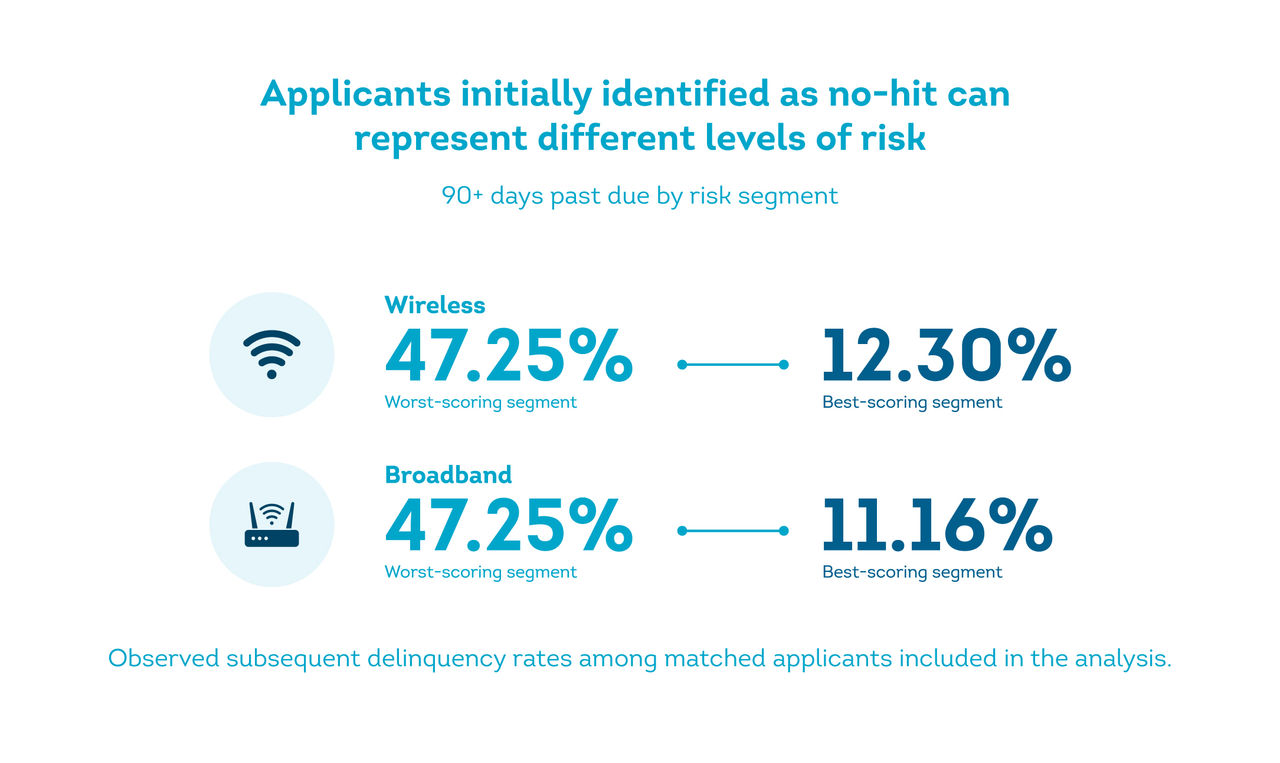
The results revealed differences scoreability alone could not. A group initially identified as no-hit contained segments with substantially different performance. For credit risk teams, the implication is worth considering: Applicants who receive similar treatment today may represent very different levels of risk.
Utility results reinforce the value of stronger segmentation
A separate retrospective analysis examined consumer applications from a large utility provider. Here, the business question expanded from whether applicants could be scored to how effectively different approaches could separate subsequent payment outcomes, including 30-day and 60-day past-due performance and one-year write-offs.
The analysis also surfaced an upstream data challenge: roughly 83,000 applications were missing a name, accounting for 82% of records categorized as “no consumers found.” This finding reinforces the importance of understanding whether an assessment gap begins with matching, available credit information or the scoring approach itself.
Among the matched consumer records included in the scoring analysis, a blended scoring approach achieved 100% scoreability. For one-year write-offs, it separated an overall 5.6% write-off rate into 24.8% in the worst-scoring segment and 2.5% in the best-scoring segment. It also captured 47.1% of one-year write-offs within the approximately 15% of applicants in the worst-scoring segment.
That kind of segmentation provides another input for decisions about how applicants should be treated. For a utility, stronger differentiation can help inform evaluations of service eligibility, deposit requirements, payment options or additional review within the organization's existing policies and requirements.
What to evaluate in your credit risk strategy
The following actions can help utilities and CSPs evaluate how effectively their credit risk strategies support customer treatment and portfolio performance.
1. Find the source of the information gap
Look at applicants your existing process has difficulty assessing. Determine how much of the issue stems from incomplete identity information, limited traditional credit history or scores that don't adequately differentiate performance.
Pinpointing the problem helps teams determine which additional information, process change or scoring method is worth evaluating.
2. Measure usable coverage
Determine how much of the target population receives a score that can meaningfully support the decision. Identify default or placeholder values that may inflate headline scoreability.
3. Validate differentiation
Compare outcomes, such as delinquency or write-offs, across score bands to determine whether the approach separates applicants with meaningfully different performance.
4. Evaluate the approach against the decision
Different decisions may call for different data and scoring approaches. Define the population, outcome and treatment decision first, then evaluate how well an approach supports them.
Blended scoring approaches can combine traditional credit information with additional data sources, while alternative approaches can help assess applicants with limited traditional credit information.
5. Connect the insight to customer treatment
Once meaningful differences emerge, consider where that information could improve customer treatment. It may help reduce unnecessary deposits or manual reviews for some applicants, identify cases that warrant additional scrutiny or apply existing policies more precisely.
Treat customers more precisely with stronger risk insights
Review where your current process produces the greatest uncertainty. That may be an applicant population with low match rates, limited traditional credit information or scores that don’t adequately distinguish subsequent payment outcomes.
Testing those populations can show whether broader data, revised scoring approaches or better upstream information could support more precise decisions about deposits, service terms, payment options and review requirements.
TransUnion® brings together identity intelligence, traditional, trended credit and alternative data and scoring solutions to help organizations evaluate where additional information could strengthen credit risk decisions.
Explore how broader data and enhanced scoring can help you assess your applicant population more effectively.