

Mortgage leaders face a persistent challenge: controlling credit costs while obtaining the information required to make confident lending decisions. A decade of mortgage credit innovation has expanded both the depth of available insight and the way lenders can sequence data, scores and decision support, helping align decisioning investment to the needs of each stage in the mortgage process.
That progress reaches beyond lender operations. More robust behavioral context can support risk assessment and investor confidence. Broader scoreability can bring additional prospective homebuyers into view. More intentional workflows can reduce unnecessary cost and friction for lenders and applicants. Each benefit depends on responsible implementation, sound governance and clear alignment between information and the decision it supports.
The evolution began by adding behavior over time to the credit picture. It continued with modern scoring models that can evaluate some consumers traditional models leave unscored. More recently, it has expanded to workflows that introduce information when it can provide the greatest decision value. The progress comes from putting broader, more relevant data to work at the right time, not simply increasing the volume of information lenders receive.
The opportunity is practical: Apply innovation to understand behavior, evaluate more consumers and strengthen decisions throughout the mortgage process.
Add historical context to understand how credit behavior is changing
A credit report or score viewed at a single moment shows an applicant's current position. Two applicants may have similar balances, available credit and overall profiles while following very different patterns of credit management. One may be steadily reducing revolving debt. Another may be taking on additional obligations. One may typically pay balances in full, while another regularly makes minimum payments.
Trended credit data adds historical context by showing how balances, scheduled payments, actual payments and utilization have changed over time. The extended view helps lenders identify meaningful differences between applicants whose current profiles look alike.
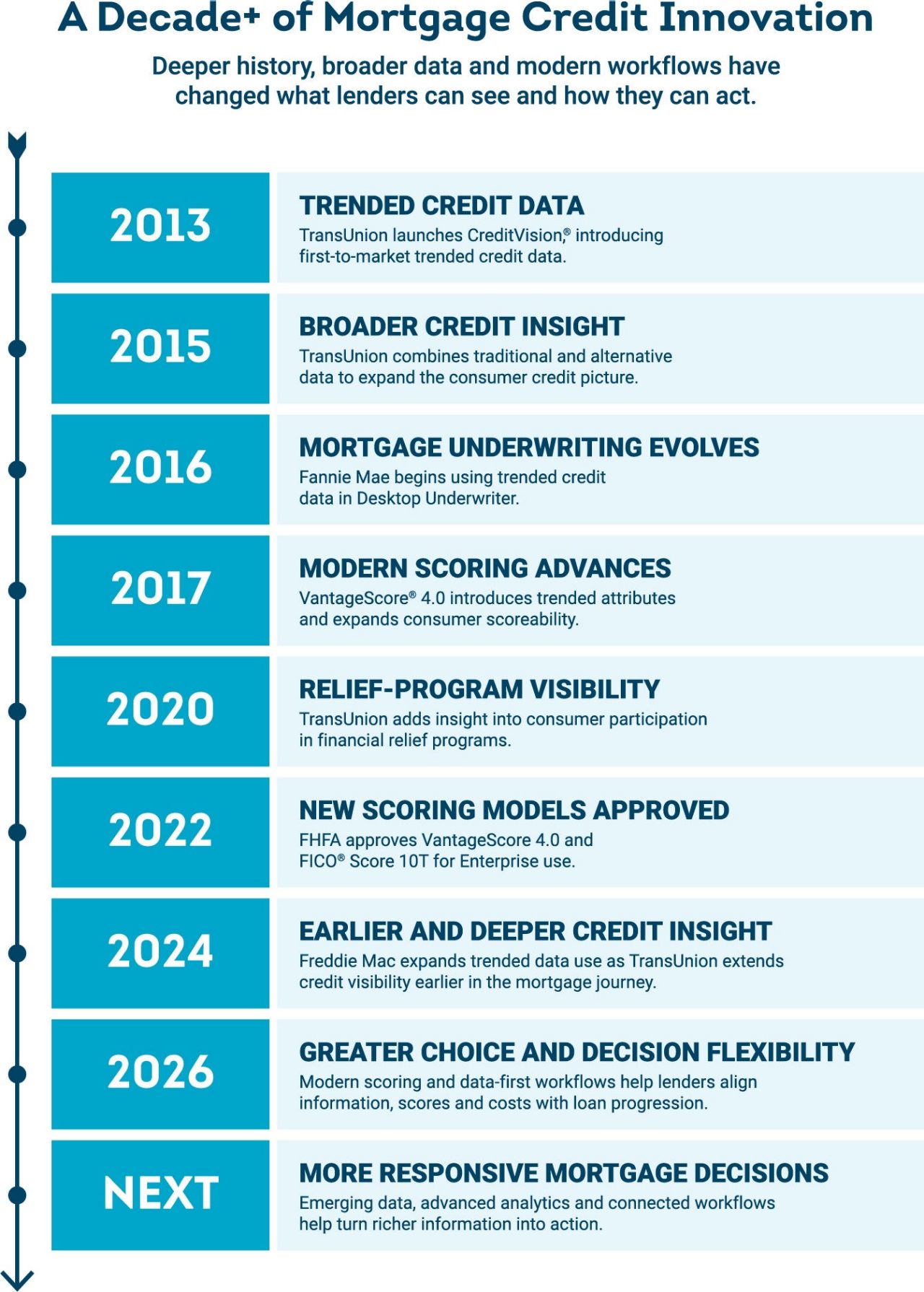
The mortgage ecosystem began putting that added dimension to work in 2016 when Fannie Mae's Desktop Underwriter began using trended credit data in its credit risk assessment.1 Freddie Mac began requiring trended data in credit reports for initial Loan Product Advisor submissions of conventional loans effective Aug. 4, 2024.2 Together, these milestones helped establish longitudinal credit behavior as part of conventional mortgage assessment.
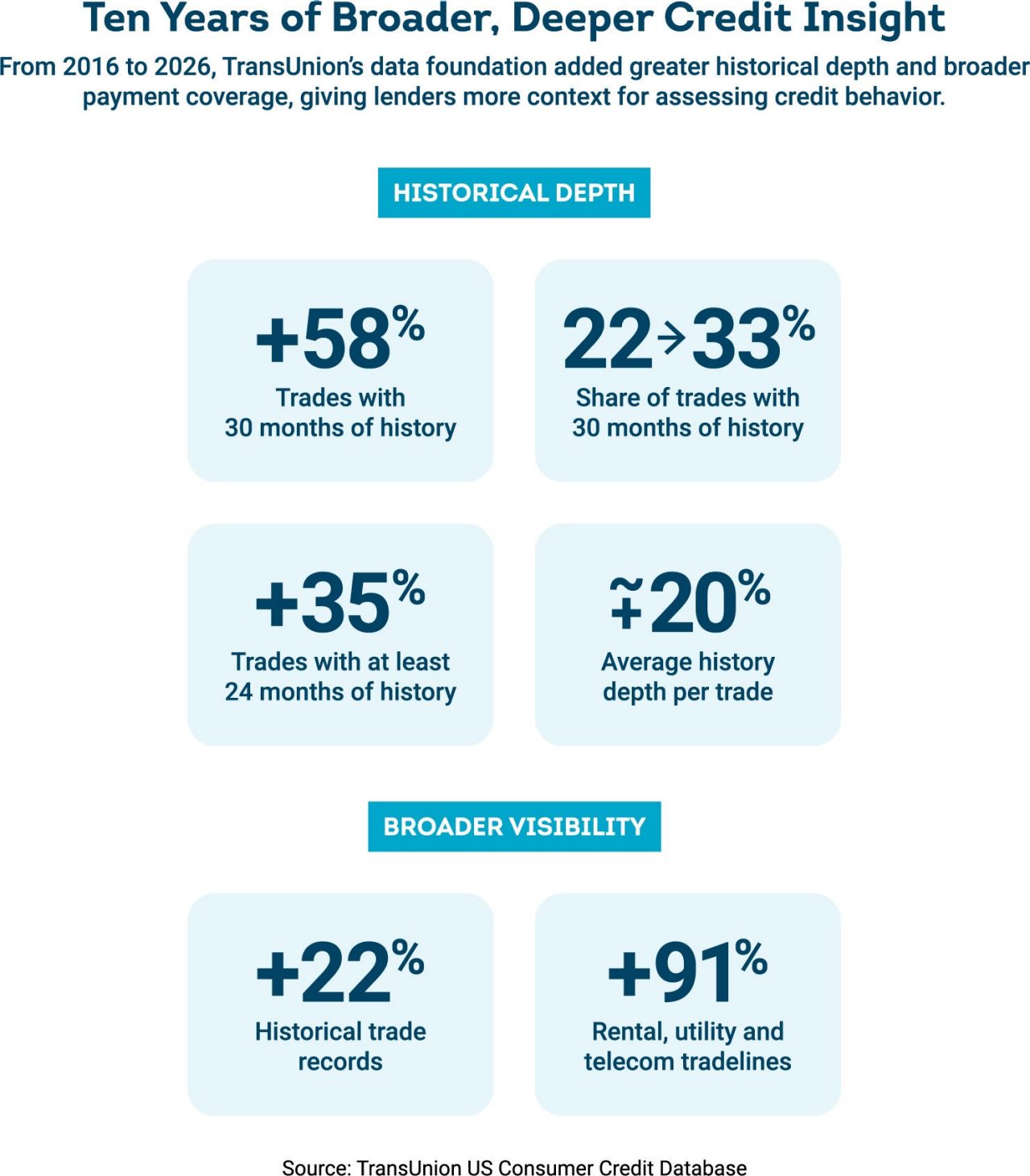
The data foundation has since grown in breadth and depth. Nearly 1 billion trades now contain at least 24 months of payment history compared to 710 million in 2016. More than 552 million trades contain a full 30 months of history, up approximately 58% from 2016, and the share of trades with a full 30 months of history increased from 22% to 33%. Average historical depth per trade also increased by approximately 20%,3 giving lenders a richer foundation for understanding how consumers manage credit over time.
Historical depth creates value when it reveals behavior relevant to risk, supports a clearer next step or helps lenders focus additional review where it can improve confidence or prevent unnecessary expense.
Expand visibility with modern mortgage credit scoring
Modern scoring models build on that richer foundation. The value of any score begins with the information beneath it, including the breadth, depth and relevance of available credit data. Updated methods can incorporate trended credit information and additional reported payment histories, such as rent and utilities, while evaluating some consumers who may not receive a score from older traditional models.
VantageScore® 4.0 incorporates trended credit information and, when available, payment histories like rent, utilities and telecom. FICO® Score 10T also incorporates trended credit information. The Federal Housing Finance Agency (FHFA) validated and approved both models for use by Fannie Mae and Freddie Mac in 2022. As of September 9, 2026, lenders approved by Fannie Mae and Freddie Mac may use VantageScore 4.0 when originating and selling eligible loans to the Enterprises, while continuing to use Classic FICO in accordance with the Selling Guides.4
Greater score choice also creates an opportunity to manage origination costs. TransUnion has made VantageScore 4.0 available for $0.99 per standalone mortgage origination score through December 2028, giving lenders greater pricing certainty as they evaluate and adopt modern scoring models. TransUnion will also continue providing VantageScore 4.0 at no additional cost to mortgage customers who purchase a FICO score.
These developments mark a shift from model approval to practical lender choice. As modern scores enter active mortgage use, lenders have a greater opportunity to evaluate how broader data and updated methods perform across their own populations, loan types and workflows.
Broader scoreability can expand the universe of prospective homebuyers lenders can evaluate. VantageScore research estimates 33 million more consumers are scoreable with VantageScore 4.0 than traditional models. The research identifies 13 million of those consumers with scores of 620 or higher and estimates 4.9 million meet its stated age and score criteria for mortgage eligibility.5 These estimates reflect potential scoreability and consideration. Mortgage eligibility and approval still depend on lender standards, underwriting, investor requirements and the applicant's full financial profile.
Expanded payment coverage helps support this broader view of consumers. Rental, utility and telecom tradelines nearly doubled6, making more alternative payment data available for consumer evaluation. When available and applicable, those payment histories can help models recognize patterns beyond traditional credit accounts.
Mortgage lenders evaluating a scoring model should consider performance across the populations and loan types they serve, the information contributing to the result, alignment with investor and workflow requirements and outcomes that will demonstrate value. Wider model availability creates choice . A disciplined evaluation process turns that choice into decision value.
Apply the right insight at the right stage of the mortgage journey
Innovation is also changing how lenders sequence information, scores and decisioning support throughout the mortgage process. Acquiring every data element, report and score before an application has progressed may create costs on loans that don’t advance. Waiting too long for information required by a meaningful decision can lead to rework, delays or avoidable risk.
Progressive mortgage workflows help lenders align information, scores and related costs with the stage and purpose of each decision. TransUnion First Look Functionality, for example, supports a data-first approach that allows lenders to begin with an early credit view and add scores as the application advances . This sequencing can support an initial eligibility assessment or prequalification discussion before additional bureau information, scores and other inputs are introduced in accordance with lender policies, underwriting process and investor guidelines require them.
Intentional sequencing connects innovation to the outcomes lenders care about. Applying the appropriate level of information at each point in the loan process can help manage expenses, improve decisioning confidence, reduce rework and create clearer applicant experiences. Effective design starts with understanding which decision each input supports and what could change if that input were introduced earlier or later.
Adoption at industry scale demonstrates how innovation can reshape established decisioning practices. From October 2016 through June 2026, more than 32 million GSE mortgage originations totaling over $9.2 trillion occurred during a period when trended data became integrated into applicable GSE underwriting workflows.7 The volume underscores how an innovation introduced more than a decade ago has become a foundational part of mortgage decisioning.
Build a mortgage credit strategy for the next decade
Mortgage leaders can start by mapping information, scores and costs across the loan process. The assessment shows how each input supports a decision, where it may enter before it provides value and where delayed insight could lead to rework or reduced confidence. It may also identify opportunities to evaluate consumers whose financial behavior isn’t fully represented by traditional approaches.
|
1. Define each stage and decision
|
Specify what the lender needs to determine during prequalification, application, underwriting and later review |
|
2. Connect each input to its purpose
|
Document how credit reports, scores, trended credit data and other information support each decision |
| 3. Assess behavioral and scoring coverage | Identify relevant borrower behaviors the current process may not make visible and populations current scoring approaches may leave unscored |
| 4. Evaluate models and timing in context | Consider performance, underlying information, populations served, loan types, investor expectations, workflow requirements and the point at which each input provides decision value. |
| 5. Measure outcomes and confirm requirements |
Assess effects on risk control, expense, rework, decision speed, applicant experience and the number of applicants who can be meaningfully evaluated.
Account for governance, organizational policies and investor guidelines before implementing changes.
|
Strong mortgage credit strategies put innovation to work across the full decision process. Deeper history helps explain behavior, modern models can bring more consumers into consideration and decision-focused workflows help lenders apply information when it can improve confidence, control costs or reduce friction.
The next decade will bring more data, analytical power and choice. Lenders that connect those advances to clear decisions, responsible data stewardship and measurable outcomes will be better positioned to strengthen risk assessment, operate efficiently and help qualified borrowers move toward closing.