
Total Economic Impact™ study of TransUnion's Synthetic Fraud Solution
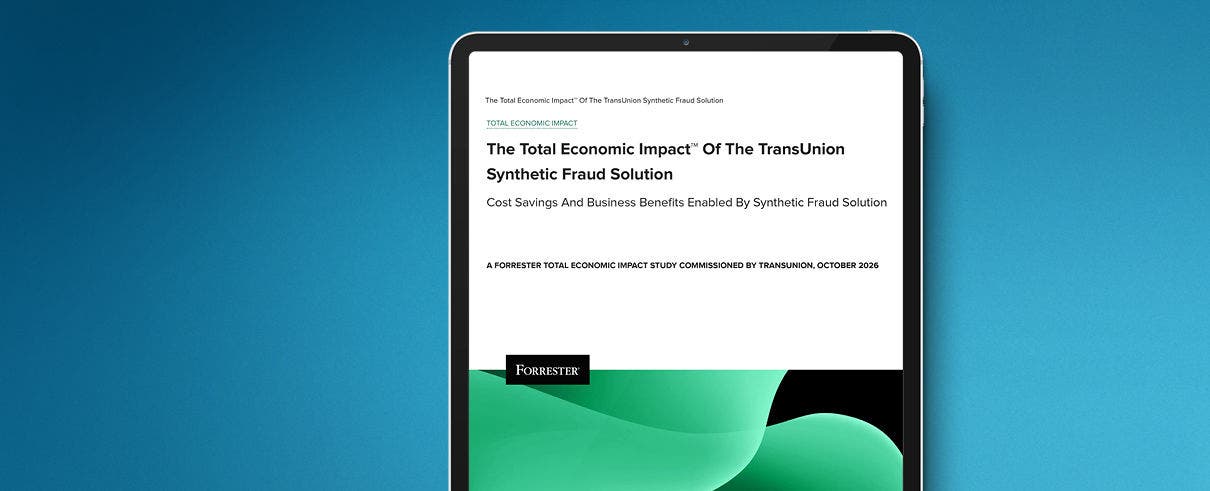
Put numbers behind the business case for stronger synthetic fraud detection.
Synthetic identities can be difficult to distinguish from legitimate applicants using traditional identity and credit verification methods alone. As these schemes become more sophisticated, organizations face a difficult balance: identify higher-risk applications while minimizing friction for legitimate customers.
To quantify the potential cost of that gap and the impact of a more targeted approach, TransUnion® commissioned Forrester Consulting to conduct a Total Economic Impact™ (TEI) study of the TransUnion Synthetic Fraud Solution. Forrester interviewed decision-makers with direct experience using the solution and combined their findings into a single composite organization, a risk-adjusted financial model representing the interviewees' collective experience rather than any single company's outcome.
Before adopting the TransUnion Synthetic Fraud Detection Solution, the decision-makers' organizations leaned on credit bureau data, manual reviews and rules-based controls that weren't built for how sophisticated synthetic identities have become. The result: more applications pulled into review, more uncertainty in approval decisions and more exposure sitting on the books. For fraud and risk leaders planning future investments, those financial and operational consequences help define the business case for more effective detection.
Study highlights
According to Forrester's modeled analysis, the composite organization achieved:
- 202% return on investment (ROI) over three years
- Payback in less than six months
Download the study to explore the:
- Assumptions behind the financial model
- Drivers of ROI and payback
- Quantified impact on fraud losses, approval decisions and operational efficiency
- Full three-year cost and benefit analysis
Who can benefit from this study
- Fraud leaders evaluating synthetic fraud prevention investments
- Credit risk leaders balancing growth and risk objectives
- Digital acquisition leaders striving to make more confident approval decisions
- Executives building a business case for fraud modernization initiatives
Explore the analysis behind the modeled results
Fill out the form to access the complete model, including:
- The full composite organization profile and assumptions Forrester used to build it, including application volume, fraud incidence rates and cost inputs
- Insights from four decision-makers with experience using the solution, including their perspectives on fraud detection, operational effort and balancing risk with growth
- The cost, benefit, flexibility and risk analysis, including fraud operations effort savings not detailed above
Complete the form to access the full Forrester Consulting Total Economic Impact™ study and evaluate how its methodology, assumptions and risk-adjusted findings could inform your company’s fraud strategy and investment decisions.
This site is protected by reCAPTCHA and the Google Privacy Policy and Terms of Service apply.

Information for Good®.
Connect with us


