
Fraud in the Age of Continuous Trust
Evaluating risk when identities, communications and established relationships are compromised
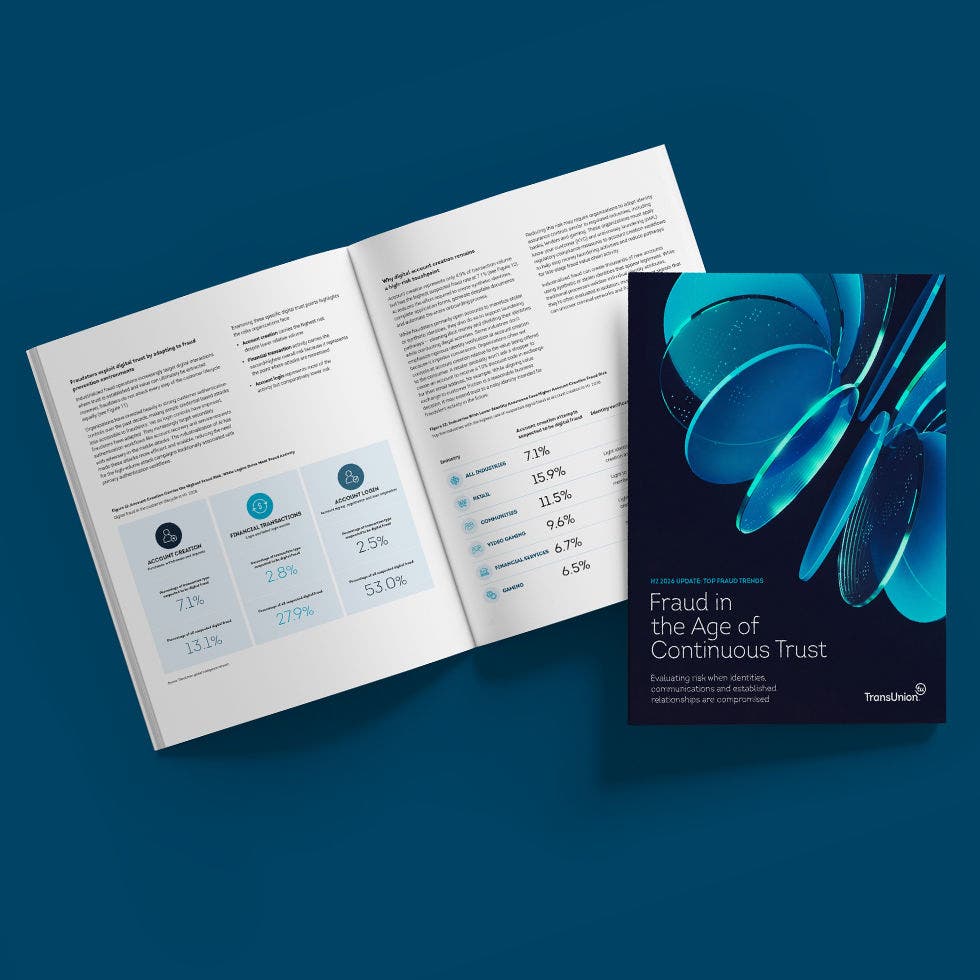
Three trends driving digital trust
Fraudsters are no longer limited to stolen credentials or isolated scams. They increasingly use synthetic identities, AI-enabled attacks and communications channels to exploit trust throughout the customer lifecycle. As a result, organizations may need to move beyond point-in-time identity verification and toward a more continuous approach to assessing trust across customer interactions.
This report examines why trust can no longer be established at onboarding alone and explores the trends reshaping fraud, identity and trust across global markets.
Manufactured identities are redefining trust
Fraudsters increasingly rely on manufactured and manipulated identities to gain access, establish credibility and evade traditional controls. The report explores why organizations may need to look beyond identity verification alone and assess trust more continuously across the customer lifecycle.
| 42% | |
|
of business leaders said their organizations are least prepared to manage synthetic identity fraud. |
|
|
Source: TransUnion business fraud survey, June 2026 |
Communications have become the new fraud battleground
Fraud increasingly begins before the traditional fraud event through brand impersonation, social engineering and trust manipulation via calls, texts and emails with consumers. These communication channels have become a vital upstream fraud signal.
| 19.4% | |
|
of outbound calls with US mobile carriers were spoofed in H1 2026. |
|
|
Source: TransUnion global intelligence network |
AI-enabled attacks have industrialized fraud
Fraud is no longer confined to isolated actors or individual schemes. The report examines how AI, automation and connected criminal networks are helping fraud operations to become more scalable, coordinated and adaptable.
| 42% | |
|
of business leaders said the increasing scale or sophistication of fraud is putting significant to severe pressure on their organizations. |
|
|
Source: TransUnion business fraud survey, June 2026 |
See where fraud is moving next
Built for fraud, risk, identity, authentication, digital channel and customer experience leaders responsible for protecting customers while supporting growth.
Access the report to:
- Explore how synthetic identities, communications-based fraud and AI-enabled attacks are reshaping digital trust
- Understand fraud and trust trends across North America, Europe, Latin America, Africa and Asia
- Identify where fraud risk emerges across onboarding, account access, communications and financial transactions
- Learn practical strategies for strengthening identity assurance and fraud prevention
- Understand how business leaders and consumers view fraud, trust and digital interactions
- Explore five predictions shaping the future of fraud, identity and digital trust
Fill out the form to access insights shaping the future of fraud and digital trust
Could not submit form.
This site is protected by reCAPTCHA and the Google Privacy Policy and Terms of Service apply.
About the Research
The report combines findings from TransUnion's global intelligence network with business and consumer research conducted across multiple markets, creating a view of fraud trends across identity, digital interactions, communications and account activity.
Learn how a connected identity intelligence framework can help protect your business and your customers.

Information for Good®.
Connect with us


