


Key Takeaways:
- When you close a financial account it can affect your credit score for several reasons.
- Closing accounts lowers your total available credit, which can increase your credit utilization ratio — a factor in credit score calculations.
- If the closed account is one of your older ones, it can shorten your overall credit history. Credit scoring models like VantageScore® 3.0 favor longer credit histories as they reflect more consistent financial behavior.
- A closed account can reduce the variety of credit types on your report, which may negatively impact your credit score.

Disclosure:
This post only contains educational information. No financial, tax or legal advice.
This information is for educational purposes only and we do not guarantee the accuracy or completeness of this information. This information does not constitute financial, tax or legal advice and you should consult your own professional adviser regarding your situation. This website may contain links to third party websites. We are not responsible for their content or data collection. Trademarks used in this material are property of their respective owners and no affiliation or endorsement is implied.
Maintaining a good credit score is a building block of your financial health. It can help you get loans, credit cards, and better interest rates. Given the importance of your credit score, it’s essential to understand how a credit score is calculated and how your actions can impact it.
Credit scores are influenced by many factors, and it’s not always straightforward to understand how different financial choices affect them. For example, a common question is: Do closed accounts affect your credit score?
Closing a financial account, like a credit card, might seem like a good idea, especially if you're trying to simplify your finances or avoid annual fees. However, this action may impact your score. Understanding what happens when you close an account and how it can change your credit score is crucial.
Read on to learn more about what having closed accounts on a credit report means for your financial health, including how to decide if closing an account is the right choice, when closed accounts can hurt or help your credit score, and how to minimize credit score damage when closing accounts.
What are credit scores and how are they calculated?
To understand how a closed account can change your credit score, it’s helpful to first look at what a credit score is and how it is calculated.
What is a credit score?
As a starting point, scores are derived from information contained in your credit report. They represent how well you manage your money and repay debts. Credit scores typically range from 300 to 850, with higher scores indicating better creditworthiness.
In general, having a higher credit score is beneficial because lenders may evaluate you as lower risk. This can lead to better loan and credit card offers, lower interest rates, higher credit limits, better insurance rates, and easier approval for rental housing. Maintaining a high credit score is crucial because it ensures you continue to enjoy these benefits. However, it is important to note that a credit score can fluctuate. And, there are many possible reasons a credit score may go down. This can sometimes include closing an account.
How is a credit score calculated?
Different scoring systems have various ways of calculating this number, but they generally consider similar factors. The graphic below contains breakdown of factors that impact a VantageScore® 3.0 credit score.
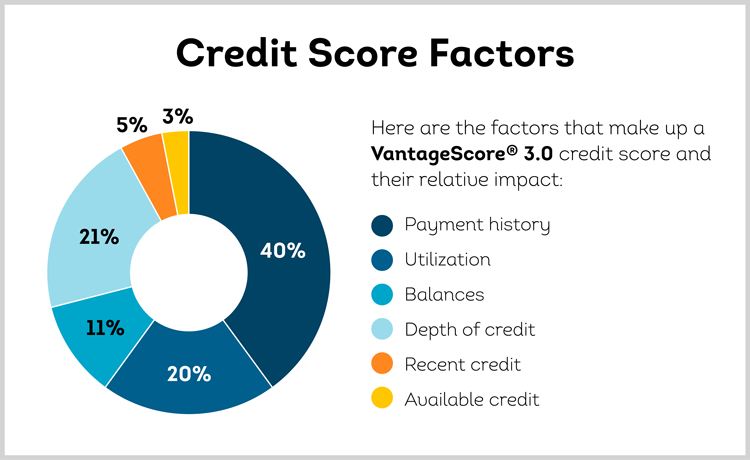
Payment history is the biggest factor; paying bills on time can help your score, while late payments can hurt it. Credit depth includes how long you've had credit and the types of credit you have, like credit cards and loans. Having a longer credit history and a mix of different credit types may help improve your score. Credit utilization primarily evaluates how much of your available credit you're using. The balances credit score factor measures the total amount owed on all of your accounts. Recent credit looks at new credit inquiries and accounts; too many new inquiries or accounts can temporarily lower your score. Finally, available credit analyzes how much credit you have at your disposal.
Why can closing accounts affect your credit score?
Closing a financial account, such as a credit card, might seem like a straightforward decision, but it can have significant implications for your credit score. Understanding these impacts can help you make informed choices and maintain a healthy financial profile.
Credit utilization impact
When you close an account, you reduce your overall available credit, which can increase your credit utilization ratio.
Above we discussed that one of the primary factors that affect a VantageScore® 3.0 credit score is “credit usage.” And a big part of credit usage is credit utilization, which refers to the amount of credit you actually use versus the amount that’s available to you. Read on to learn more and get a detailed explanation.
How to calculate credit utilization
Follow these steps to calculate your credit utilization ratio:
- Add up all the balances (the money you owe) on all of your revolving accounts, like credit cards together. This is your “combined balance.”
- Add up all the credit that is available to you on all your cards together. This is your “total credit limit.”
- Divide your “combined balance” by your “total credit limit” to get your credit ratio.
For example, if you have two credit cards with the following limits and balances:
- Card 1: $4,000 limit, $1,800 balance
- Card 2: $6,000 limit, $1,200 balance
So, to calculate credit utilization, simply:
- Calculate total credit limit: $4000 + $6,000 = $10,000
- Calculate combined balance: $1,800 + $1,200 = $3,000
- Divide your combined balance by total credit limit: $3,000/$10,000 = 30%
Credit Utilization Formula
all credit cards
$10,000 total credit limit
across all credit cards
What can happen to utilization when you close a credit card?
In this case, your credit utilization ratio is 30%. Keeping your credit utilization below 30% is a good rule of thumb, but lower usage is more favorable. However, what would happen if you decided to close out one of your credit cards?
Now, let's examine the impact of closing Card 2:
- Card 1: $4,000 limit, $1,800 balance
- Card 2: $6,000 limit, $1,200 balance (closed)
The person does a good job paying off that balance and closed Card #2, with a $4,000 limit and $1,800 balance remaining. This brings their credit utilization to 45%, which can significantly impact your credit score. Higher utilization ratios can signal to lenders that you might be overextended and could have trouble repaying debts, which can negatively affect your credit score.
However, if the person paid off Card #2 in full and kept it open, they would have a $10,000 limit and $1,800 balance and their utilization would be 18%, below the 30% rule of thumb.

Pro Tip:
Even if you close an account and pay off the balance in full, your credit utilization could still go up because your total available credit decreases. Always consider how closing an account will affect your overall credit limits and utilization ratio.
Impact of credit history age
Above we pointed out that one of the VantageScore® 3.0 credit score factors is “credit depth”, which considers several aspects, including age of your credit history.
Here’s what that means:
- Oldest account: How long your very first credit account has been open.
- Youngest account: How recently you opened your newest account.
- Average age: The average age of all your credit accounts combined.
These details can help lenders understand how experienced you are with using credit.
Why closing an old account can hurt your score
Closing an old credit account doesn’t hurt your credit score right away. If the account was in good standing, it stays on your credit report for up to 10 years. During that time, it still helps your credit score by showing a longer credit history and boosting the average age of your accounts.
But after 10 years, the account disappears from your credit report. That’s when your score can be affected in two ways:
- When the account is removed, the average age of your credit accounts goes down. A shorter average age can make it look like you have less experience with credit, which may lower your score.
- If the account you closed was your oldest, your credit history will look shorter once it’s gone. That can also hurt your score because longer credit histories are a net-positive for your score.
So, while closing an old account doesn’t cause an immediate drop in your score, it can have a delayed effect once the account is no longer part of your credit report.
Here’s an example to demonstrate.
Let’s suppose you have a credit card account that you've had for 10 years and decide to close it. Doing so could reduce the average age of your accounts, making your credit history appear shorter.
By closing the old account, the average age of your credit history drops significantly, which can negatively impact your credit score. Keeping older accounts open helps maintain a longer credit history, which is beneficial for your credit score.
How to determine if closing an account is the right decision
In most financial matters, it’s good to carefully consider potential benefits and risks before making a decision. This thinking also applies to deciding if you should close a credit account or not. After all, a closed account on your credit report might impact your score.
That said, there also may be circumstances when it’s better for you to close the account. The sections below cover some things to consider if you have an account you want to close.
Situations when closing accounts might be beneficial
While closing accounts can sometimes lower your credit score, there are situations where it might be beneficial overall, such as simplifying or improving your financial health.
Here are a few examples:
- Simplifying finances. Closing some accounts can make it easier to manage your finances and reduce the risk of missed payments.
- Lowering debt. Paying off a balance and closing the account can lower overall debt load, especially if you are carrying too much.
- Avoiding fees. Closing accounts with annual fees or maintenance charges can save money.
- Security concerns. Fewer accounts can lower the risk of fraud or identity theft by making accounts easier to monitor and track.
On top of these considerations, there may be other reasons driving your decision to close out an account, such as significantly high fees, life changes such as marriage or having a child, or even finding a more desirable credit card.more desirable credit card.
Situations when closing accounts may not be beneficial
Depending on your financial goals and situation, sometimes it's worth keeping an account open even if you don't plan to use it.


- Credit utilization. As outlined above, your credit utilization ratio is your total credit balance divided by the total credit that’s available to you. Ideally, keep it under 30%. Closing accounts lowers your available credit and may increase this ratio, hurting your credit score.
- Credit length. The age of your accounts affects your credit depth, a score factor mentioned earlier. A longer history demonstrates your ability to manage credit well over time. Closing older accounts may shorten your history and potentially hurt your score.
- Credit mix. The other factor in credit depth is the mix of accounts, such as credit cards, mortgages, personal loans, etc. Closing an account may reduce this mix and lower your score.
All of these factors could impact your credit score if you close accounts. However, again, depending on your financial situation and goals, closing accounts may or may not be the right choice for you.
Bottom Line:
Ultimately, only you can decide whether or not a potential reduction in your credit score is worth closing out an account, and in some cases, it may very well be.
Alternatives to closing accounts
What should you do if you have an account you don’t want to use or need anymore? If you’re worried that closing an account might hurt your credit score, consider some alternatives:
| Alternative | Description | Benefits |
|---|---|---|
| Reduce usage | Use the account less frequently but keep it active. | Maintains credit history and utilization ratio without incurring more debt. |
| Downgrade the Account | Ask your lender to switch to a no-fee or lower-fee account. | Saves money on fees while potentially keeping the account open. |
| Decrease the credit limit | Keep the account active but decrease credit limit. | Maintains credit history and credit mix aspects. However, lowering your credit limit reduces total available credit which can cause credit utilization to increase, which can negatively impact your score. You still benefit from having the account open, but the positive effect is smaller due to the lower limit. |
How to remove closed accounts from your credit report
Understanding accounts on your credit report
It's important to know that closed accounts don't automatically fall off your credit report. Remember, as we discussed, your credit history is a component of credit scoring models. As such, a closed account will remain on your report. How long it stays depends on the account’s history.
Satisfactory accounts stay longer than accounts with adverse information. Over time, the impact of accounts with adverse information on your credit score diminishes.
- Satisfactory Accounts: Accounts with a good payment history stay on your credit report for up to 10 years. This may positively impact your credit score by showing a history of responsible credit use.
- Accounts With Adverse Information: Generally, missed payments and collections stay on your report for up to 7 years (with some exceptions). Chapter 7 bankruptcies remain for 10 years, while Chapter 13 stays for 7 years.
If you want to remove a closed account from your report, then you need to wait for natural removal as outlined above.
Removing accounts with inaccurate information
But if your closed account contains inaccurate information or is the result of fraud, you can file a dispute with the nationwide credit bureaus: TransUnion, Experian and Equifax. You'll need to provide documents to prove the errors. The credit bureau will investigate, and if the information is wrong, it will be corrected or removed.

Pro Tip:
You can submit a dispute online for free through the TransUnion Service Center.
Keeping an eye on your credit after closing an account
As we’ve discussed, closing a credit card or loan might seem simple, but it can affect your credit score in ways you might not expect. It can change your credit utilization, shorten your credit history, and impact your credit mix—all of which play a role in your score.
Step 1: Check your report
Just because you closed an account doesn’t mean it disappears right away. It can take a few weeks for the closed account to show up on your credit report. And remember that the closed account will remain on your credit report for years: Accounts in good standing typically remain on your report for up to 10 years. And negative accounts for 7 years.
After closing an account, check your credit report to make sure everything looks right.You can get a free credit report from TransUnion - that can be updated daily. Or visit www.annualcreditreport.com to get a free report from each of the three major credit bureaus weekly.
How TransUnion can help
Once you’ve reviewed your credit report, consider taking a more proactive approach to stay on top of your credit. Because after you close an account, your credit story doesn’t stop. With free credit monitoring from TransUnion, you get more than just a snapshot of your credit—you get a full picture, updated daily.
Here’s what you get – all 100% free:
- Credit monitoring alerts: Get notified right away if something important changes—like a sudden drop in your score, a new account opened in your name, or a major shift in your credit usage. These alerts help you act fast and stay protected.
- Unlimited access to your score and report: Check your credit score and report as often as you want. No waiting, no guessing—just clear, up-to-date info at your fingertips.
- Insights and tools: Understand what’s helping or hurting your score. Review key credit score factors and tips so you can take control of your credit future.
Frequently Asked Questions When Closing Accounts:
These accounts aren’t reported to credit bureaus because they don’t involve borrowing. But if you close an overdrawn account without paying the balance, the bank may send the debt to collections, which can show up on your credit report and hurt your score.


